Moving to Bournemouth in 2026? A Practical Guide to Living in Bournemouth
Thinking About Moving to Bournemouth?
Bournemouth is a coastal town in Dorset, on the south coast of England, known for its long sandy beach, town centre and large student population. It forms part of the Bournemouth, Christchurch and Poole (BCP) local authority area, but Bournemouth itself includes a number of different neighbourhoods with their own character and housing options.
Living here means having the coast close by while still having the shops, schools, healthcare, transport and other services you would expect from a large town. Bournemouth also has direct rail connections towards London, Southampton and other parts of the South Coast.
The area ranges from busy central neighbourhoods and student areas to quieter residential parts further from the seafront, so where you choose to live can make a noticeable difference to everyday life.
Before deciding whether Bournemouth is right for you, it’s worth looking at the practical details - including house prices, rent, schools, transport, safety, population, local amenities and what it’s really like to live here in 2026.
Is Bournemouth a Good Place to Live?
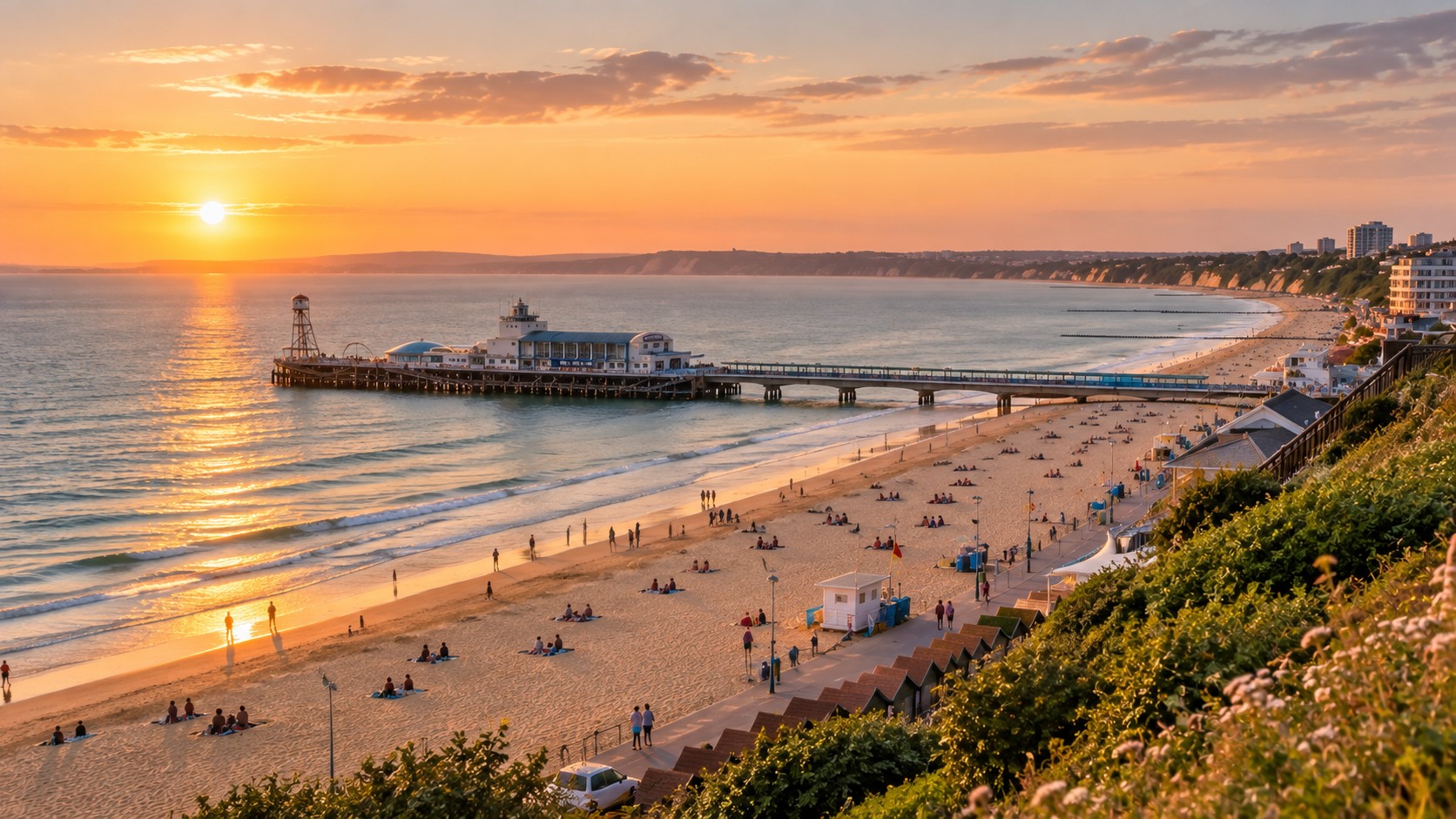
Bournemouth can be a good option if being close to the coast is important to you but you still want the services and transport links of a large town. Bournemouth has around seven miles of coastline, while the wider BCP area includes Bournemouth, Christchurch and Poole.
One of the biggest differences compared with many inland towns is how much the beach and seafront become part of everyday life. At the same time, Bournemouth has a busy town centre, shopping, restaurants, schools, healthcare and several distinct residential areas, so living here doesn't necessarily mean living in the middle of a tourist area.
Transport is another advantage. Bournemouth railway station has direct services to London Waterloo and Southampton, with the London journey taking around two hours depending on the service.
There are some trade-offs. Bournemouth gets much busier during the summer, and the experience of living in the town centre can be very different from living in areas further from the seafront. Housing costs, parking and your distance from the station or main bus routes are all worth checking before choosing a property.
The exact neighbourhood matters a lot here, so later in the guide we'll look separately at areas such as Westbourne, Southbourne, Boscombe and Charminster rather than treating the whole of Bournemouth as if it feels the same.
Where Is Bournemouth?
Bournemouth is on the south coast of England in Dorset, between Poole to the west and Christchurch to the east. It forms part of the wider Bournemouth, Christchurch and Poole (BCP) area, which has been governed by BCP Council since 2019.
Bournemouth itself is made up of several different neighbourhoods, including areas such as Westbourne, Boscombe, Southbourne, Winton, Charminster, Kinson and parts of the town centre and seafront. The exact area you choose can make quite a difference when it comes to property prices, access to the beach, transport and the general feel of where you live.
One thing worth knowing when searching for a property is that Bournemouth doesn't have just one postcode. Addresses across the town use several BH postcode districts, so it's always worth checking the full address rather than assuming that every BH postcode is in Bournemouth.
Since 1 April 2026, Bournemouth has also had its own civil parish, with 10 parish wards. This sits within the wider BCP Council area and doesn't change the fact that Bournemouth, Christchurch and Poole remain distinct places.
For anyone moving from further away, Bournemouth is also well connected to other parts of the South Coast, while London is accessible by direct rail services. We'll look at the actual transport options in the next section.
Transport & Commuting
Bournemouth has good rail and bus connections, although how easy it is to get around day to day will depend on where in the town you live.
Bournemouth railway station is the main station serving the town. South Western Railway operates services on the Bournemouth–London Waterloo route, while CrossCountry connects Bournemouth with destinations including Southampton, Oxford, Birmingham and Manchester. Southampton can be reached by direct train in under 30 minutes on some services.
For local travel, Bournemouth has an extensive bus network connecting the town centre with areas including Boscombe, Southbourne, Charminster, Winton, Kinson and Westbourne, as well as neighbouring Poole and Christchurch. BCP Council also supports a number of local routes where they are considered necessary for residents.
If you're moving here without a car, it's worth checking the bus route and distance to the nearest stop before choosing a property. Some residential areas are much better connected than others, and living close to Bournemouth station isn't essential if you have a useful bus route nearby.
Bournemouth Airport is outside the main urban area, north-east of the town. There is a limited bus connection from Bournemouth Square and the railway station, so for regular airport travel it's worth checking the current timetable rather than assuming there is a frequent service.
For drivers, Bournemouth is connected to the wider road network via the A338, but traffic can be heavier around the town and main routes at busy times, particularly during the summer season.
💙 Movly tip: When comparing properties, check your actual commute from the full postcode rather than looking only at the distance from Bournemouth town centre. In a spread-out town like Bournemouth, two addresses a few miles apart can give you quite different everyday journeys.
House Prices in Bournemouth
Property prices in Bournemouth vary quite a lot depending on the type of home and the part of town you're looking at.
According to Rightmove, properties sold in Bournemouth for an average of around £347,000 over the last year. Flats made up a large proportion of sales and averaged around £224,000, while semi-detached homes averaged about £350,000 and detached properties around £495,000. Rightmove's figures are based on HM Land Registry sold-price data.
It's worth separating this from the official figures for the wider council area. ONS data shows an average house price of around £310,000 across Bournemouth, Christchurch and Poole in July 2026, but that figure covers the whole BCP local authority rather than Bournemouth alone.
Prices within Bournemouth can also change noticeably between neighbourhoods, so the town-wide average is only a starting point. Areas close to the coast can have a very different property market from more residential parts further inland.
When comparing homes, look at recent sold prices for the specific street or postcode, rather than relying only on the Bournemouth average. This is especially useful here because the housing stock ranges from town-centre and seaside flats to family houses in areas such as Southbourne, Winton and Kinson.
💙 Movly tip: Save the full postcode of any property you're considering and compare the local area alongside the asking price. A cheaper property isn't always the better option once commute, parking and everyday travel are taken into account.
Renting in Bournemouth
Bournemouth has a large rental market, with everything from town-centre and seaside flats to family homes further inland. Prices vary depending on the neighbourhood, property size and how close you are to the coast or town centre.
The latest ONS data shows that the average private rent across Bournemouth, Christchurch and Poole was £1,398 per month in August 2026, up 2.8% from £1,360 a year earlier. This figure covers the whole BCP local authority, not Bournemouth alone, so it should be used as a general benchmark rather than an exact Bournemouth average (ONS, 2026).
By property size, average monthly rents across BCP were £918 for a one-bedroom property, £1,169 for two bedrooms, £1,456 for three bedrooms and £2,080 for homes with four or more bedrooms in August 2026 (ONS, 2026).
Current Bournemouth listings show how much prices can vary within those averages. Two-bedroom flats are currently being advertised from around £1,100–£1,350 per month in many cases, although properties in particular locations or with features such as sea views can cost considerably more (Rightmove, 2026). Three-bedroom houses commonly appear around £1,500-£1,800 per month, with larger, recently renovated or particularly well-located homes going above this range (Rightmove, 2026).
If you're planning to rent in Bournemouth, compare properties by full postcode rather than price alone. A flat close to the beach, a house in Winton and a property further north can give you very different access to transport, parking and everyday amenities.
It's also worth checking exactly what's included before comparing monthly costs, particularly council tax, parking and energy costs, as these can make a noticeable difference to your overall budget.
Popular Areas in Bournemouth
Bournemouth is made up of several neighbourhoods, and where you live can make quite a difference to how close you are to the beach, town centre, transport and everyday amenities.
Westbourne sits west of Bournemouth town centre and has its own shopping area, with cafés, restaurants and local services. It's also close to the coast around Alum Chine, so it can work well if you want access to the beach without living directly in the town centre. Westbourne is recognised as a distinct local area by BCP Council and includes its own conservation area. (BCP Council, 2026).
Southbourne is east of central Bournemouth and is another area worth looking at if being close to the coast matters to you. The wider Southbourne area stretches towards Tuckton and Hengistbury Head, while Southbourne itself has local shops and services away from the main Bournemouth town centre. BCP Council's current boundaries include Southbourne and Tuckton as a distinct part of Bournemouth. (BCP Council, 2026).
Boscombe and Pokesdown are closer to Bournemouth town centre and the eastern seafront. Boscombe has its own shopping centre and access to the beach, while Pokesdown also has its own railway station. BCP Council groups Boscombe and Pokesdown together within one of Bournemouth's new parish wards. (BCP Council, 2026).
Winton and Charminster are further inland and have their own local high streets, shops and services. They're also close to Bournemouth University's Talbot Campus, which means parts of this side of Bournemouth have a noticeable student population and a larger number of shared homes. Winton and Charminster appear separately in ONS local statistical areas, so it's worth checking the exact postcode when comparing properties here. (ONS, 2026).
Kinson is in the north-west of Bournemouth, further from the seafront and town centre. It has its own local centre and is officially one of Bournemouth's parish wards. For someone who doesn't need to be within walking distance of the beach, it's another part of the town worth including in a property search. (BCP Council, 2026).
There isn't one part of Bournemouth that will suit everyone. Before choosing an area, check the full postcode, commute, parking, distance to the beach and the local transport options rather than relying only on the neighbourhood name.
Bournemouth Postcodes
Bournemouth uses the BH postcode area, but it's important to know that the wider BH area extends beyond Bournemouth and also covers other parts of Dorset and neighbouring Hampshire. Royal Mail is responsible for setting the post town and postcode for a property, while BCP Council manages official street naming and numbering within the local authority area (BCP Council, 2026).
Bournemouth addresses use a number of postcode districts, with BH1 to BH11 associated with the Bournemouth post town. However, postcode boundaries don't always match neighbourhood boundaries exactly, so they should be treated as a guide rather than strict local borders.
When you're looking at properties, always check the full postcode and address rather than relying on the first part of the postcode alone. This will give you a more accurate picture of the neighbourhood, nearby schools, transport and local services.
Moving to Bournemouth with Children
Bournemouth has quite a lot to offer families outside school. The beach is an obvious advantage, with miles of coastline for walks, cycling and days by the sea, while parks, gardens and nature areas provide plenty of other options for spending time outdoors.
There are also things to do when the weather isn't ideal. Bournemouth has family attractions including the Oceanarium, indoor climbing and activities at RockReef on Bournemouth Pier, as well as museums, libraries, leisure centres and other indoor activities around the town (Bournemouth Tourism, 2026).
For younger children and families looking for regular local activities, BCP Council's Family Information Directory is particularly useful. It lists parent and toddler groups, sports and play sessions, arts and crafts, youth clubs, holiday activities and events taking place across Bournemouth and the wider BCP area. Local libraries also run activities for children and young people (BCP Council, 2026).
Education is another important part of choosing where to live, and Bournemouth has nurseries, primary and secondary schools as well as further and higher education options. We've covered these separately in the Education in Bournemouth section below, including what to check before choosing a home around a particular school.
For parents, the main thing is to look at what everyday family life would actually be like from the address you're considering. Check the school or nursery journey, nearby parks and activities, public transport and how easy it would be to reach the places your family would use regularly. These can vary quite a lot between Bournemouth's neighbourhoods.
Education in Bournemouth
For families with younger children, Bournemouth has a range of nurseries, pre-schools, playgroups and registered childminders. BCP Council's Family Information Directory can be used to search for local childcare providers, including day nurseries offering full- and part-time care and early years education. Funded childcare is also available for eligible families, although the hours and eligibility depend on the child's age and family circumstances (BCP Council, 2026).
Bournemouth also has a wide choice of primary and secondary schools, but if schools are an important part of your move, it is worth checking them at address level rather than just by neighbourhood. BCP Council makes clear that living within a catchment area does not guarantee a place, and some schools do not use catchment areas at all (BCP Council, 2026).
At primary level, Avonwood Primary School on Harewood Avenue is one example. It teaches children aged 4-11 and was rated Outstanding following its April 2024 Ofsted inspection (Ofsted, 2024). Winton Primary School on Oswald Road is another large primary serving children aged 4-11 (Ofsted, 2024).
For secondary education, Bournemouth has several different options. Winton Academy, a boys' school for ages 11-16, was inspected in May 2024 and remains Outstanding, while Glenmoor Academy, a girls' school for ages 11-16, had its latest inspection in December 2024 and is also Outstanding (Ofsted, 2024–2025).
Bournemouth also has selective education. Bournemouth School is a boys' grammar school for ages 11-18 and was rated Outstanding at its February 2024 inspection. Bournemouth School for Girls is another selective option in the town. Applications to grammar schools involve additional admission requirements, so parents should check the individual school's current policy rather than assuming that living nearby gives priority (Ofsted, 2024; BCP Council, 2026).
If you're moving to Bournemouth during the school year, availability is especially important. BCP Council says that many schools across Bournemouth, Christchurch and Poole are already full, and moving into an area does not automatically mean there will be a place at the nearest school (BCP Council, 2026).
For further and higher education, Bournemouth is also home to a large student community. Bournemouth University has two main campuses, Talbot and Lansdowne. Most undergraduate and postgraduate courses are delivered at Talbot Campus, while Lansdowne is home to most of the university's Health & Social Sciences teaching and the majority of its student accommodation (Bournemouth University, 2026).
Arts University Bournemouth is another higher education option in the area, specialising in creative subjects. Its campus is located close to Bournemouth University's Talbot Campus.
Before committing to a property, families should check childcare availability, the latest Ofsted information and individual school admissions policies where relevant. For university students, it's worth checking the location of their course and campus before choosing where to live, as this can make a noticeable difference to the daily journey.
Is Bournemouth a Safe Place to Live?
Safety can vary quite a lot across Bournemouth, so it's worth checking the exact area you're considering rather than relying on one figure for the whole town.
Dorset Police divides Bournemouth into several neighbourhood policing areas, and the latest data shows different patterns depending on location. For example, in Bournemouth North East, the most commonly reported categories in July 2026 were violence and sexual offences, anti-social behaviour and shoplifting (Dorset Police, 2026). In Bournemouth East-West, anti-social behaviour was the most commonly reported category during the same month (Dorset Police, 2026).
The town centre and seafront also need some context. Dorset Police identifies Bournemouth Central as an area with a particularly busy daytime and night-time economy and large numbers of visitors, especially during summer. Its March 2026 ASB Action Plan notes that Bournemouth Central records a higher share of some types of public-place crime than other policing sections in Dorset, partly in the context of its large town centre, nightlife and seasonal visitor numbers (Dorset Police, 2026).
During busy summer periods, Dorset Police also runs additional patrols around Bournemouth Beach. In its September 2026 update, the Bournemouth South neighbourhood team reported targeted patrols and enforcement aimed at anti-social behaviour and disorder around the beach and town-centre areas (Dorset Police, 2026).
For anyone moving to Bournemouth, the most useful approach is to check crime data using the full postcode or street. Dorset Police provides local crime maps and neighbourhood information, allowing you to look at the area immediately around a property rather than judging Bournemouth as a whole (Dorset Police, 2026).
Local Life & Amenities
Bournemouth's beach and seafront are a big part of local life, but there is more to the town than the coast. Bournemouth Pier is one of its best-known landmarks, with attractions on the pier and views across the bay. The Lower Gardens connect the seafront with the town centre and form part of Bournemouth's historic gardens, which still retain much of their Victorian character (Bournemouth Tourism, 2026).
One of the town's most distinctive cultural attractions is the Russell-Cotes Art Gallery & Museum on the East Cliff. The Victorian villa was the home of collectors Sir Merton and Lady Annie Russell-Cotes and now contains art and objects collected during their travels, including Victorian and Pre-Raphaelite works (Bournemouth Tourism, 2026).
If you're interested in Bournemouth's history, the Bournemouth Cultural Trail is another way to explore the town. The route takes in historic buildings and architecture around the town centre, the listed gardens and seafront, including Bournemouth Pier and the Russell-Cotes. It also passes places connected with Bournemouth's literary history, including the grave of Frankenstein author Mary Shelley (Bournemouth Tourism, 2026).
For outdoor activities beyond the central beach, Hengistbury Head is one of the most interesting places to visit. The nature reserve combines coastal walks and wildlife with thousands of years of archaeological history, making it quite different from Bournemouth's busier central seafront (Bournemouth Tourism, 2026).
Bournemouth also has entertainment and activities throughout the year, including the Oceanarium, RockReef and PierZip on Bournemouth Pier, theatres, galleries and seasonal events. The town centre has the usual high-street shopping and restaurants, while areas such as Westbourne, Southbourne, Boscombe and Winton have their own smaller local centres.
For someone considering a move rather than simply visiting, it's worth looking at which of these places would actually be part of your everyday life. Living near the town centre and seafront gives you very different access to attractions and entertainment from living further inland in areas such as Kinson or Winton.
Healthcare in Bournemouth
Bournemouth has GP surgeries, pharmacies and hospital services across the town. If you're moving to a new area, it's worth checking which GP practices accept patients from your new address, as practice boundaries can vary. You can search and register using your postcode through the NHS Find a GP service (NHS, 2026).
The main hospital in Bournemouth is Royal Bournemouth Hospital on Castle Lane East (BH7 7DW), run by University Hospitals Dorset NHS Foundation Trust. It provides services for people living across Bournemouth, Christchurch, East Dorset and surrounding areas (University Hospitals Dorset, 2026; NHS, 2026).
There have been important changes to local hospital services in 2026. Royal Bournemouth Hospital is being developed as University Hospitals Dorset's major emergency hospital, while Poole Hospital is planned to become the trust's main planned-care site. Some of the service moves planned for 2026 have been delayed, and Poole Hospital's Emergency Department remains open while the changes are completed (University Hospitals Dorset, 2026).
For health problems that aren't life-threatening, NHS 111 can direct you to the most appropriate local service. University Hospitals Dorset also advises that people attending A&E with minor conditions may be directed back to their GP, a pharmacy or another suitable service (University Hospitals Dorset, 2026).
If healthcare access is particularly important for your move, check the distance from the exact property to your GP, pharmacy and hospital rather than assuming everything will be close because the address is in Bournemouth.
Green Spaces & Outdoors
Living in Bournemouth gives you access to more than just the beach. There are parks, gardens, nature reserves and walking routes across different parts of the town, so you don't necessarily need to live near the seafront to have outdoor space nearby.
The Lower, Central and Upper Gardens run for around 3 kilometres from Bournemouth Pier towards the boundary with Poole. All three have held Green Flag status since 1999 and form part of the Bourne Valley Greenway. There is also a cycle route running through the gardens from the town centre towards Branksome (BCP Council, 2026).
Closer to the town centre, Meyrick Park provides open green space alongside tennis courts, bowling, rugby, golf and gym facilities (BCP Council, 2026). Further east, Queen's Park combines woodland and informal green space with a playground and public golf course, while Seafield Gardens in Southbourne has tennis courts, a play area and recreation space (BCP Council, 2026).
For something less urban, Bournemouth also has access to areas including Hengistbury Head, Stour Valley Nature Reserve, Kinson Common and Turbary Common, offering options for walking and spending time outdoors away from the town centre (Bournemouth Tourism, 2026).
And of course, the coastline is one of Bournemouth's biggest outdoor spaces. Depending on where you live, you may be closer to the central beach, Boscombe or Southbourne, so it's worth checking the walking or cycling distance from the exact property rather than simply looking at how far it is from Bournemouth town centre.
Jobs & Working in Bournemouth
Bournemouth has employment across a mix of sectors, including healthcare, retail, hospitality, education, finance and professional services. Across the wider Bournemouth, Christchurch and Poole area, health and social care is the largest employment sector, accounting for around 35,000 jobs, followed by retail with around 25,000 and accommodation and food services with around 19,000. These figures cover the whole BCP area rather than Bournemouth alone (ONS/Dorset Council, 2025).
Tourism and hospitality remain an important part of the local economy, which isn't surprising given Bournemouth's beaches, hotels, restaurants and visitor economy. BCP Council also identifies digital, finance, engineering, tourism and education among the key sectors it promotes for local investment and business growth (BCP Council, 2026).
Another employment area is around Bournemouth Airport and the neighbouring Aviation Business Park. The airport itself employs around 450 people, while the wider business park is home to approximately 200 businesses supporting more than 4,000 local jobs. Further airport expansion approved in 2025 is expected to create additional employment (Bournemouth Airport, 2025-2026).
Bournemouth also works as a base for people who work remotely or commute elsewhere along the South Coast. Direct rail connections towards Southampton and London can widen the area you can realistically consider for work, although the journey and cost are worth checking before relying on a regular commute.
If you're moving to Bournemouth for a new job, check the commute from the actual property rather than Bournemouth as a whole. Living in Southbourne, Kinson or Westbourne, for example, can give you quite different travel times depending on where you need to work.
Cost of Living in Bournemouth
The cost of living in Bournemouth will depend heavily on your housing costs, whether you rent or own, and how much you rely on a car or public transport.
Housing is likely to be one of the biggest monthly expenses. Across the wider Bournemouth, Christchurch and Poole area, the average private rent was £1,398 per month in August 2026. The average was £918 for a one-bedroom property, £1,169 for two bedrooms and £1,456 for three bedrooms. These figures cover the whole BCP area rather than Bournemouth alone (ONS, 2026).
Council Tax is another cost to include in your budget. For 2026/27, BCP Council increased its Council Tax element by 6.74%. In the Bournemouth Town Council area, the total annual charge ranges from £1,619.64 for Band A to £4,858.92 for Band H, with a Band D property charged £2,429.46 (BCP Council, 2026).
Energy costs will depend on the property, tariff and how much energy you use. From 1 October to 31 December 2026, Ofgem's energy price cap for a typical household paying by Direct Debit will be £1,723 per year. This isn't a maximum household bill - actual costs still depend on energy use (Ofgem, 2026).
When comparing properties, look beyond the rent or mortgage payment. Council Tax, energy, water, broadband, parking and commuting costs can make a noticeable difference to what you actually spend each month.
For Bournemouth in particular, location can affect that calculation too. A property that lets you walk or take the bus to work may work out differently from one where you need to drive and pay for parking regularly.
Population & Local Community
Bournemouth is one of the main population centres within the wider Bournemouth, Christchurch and Poole area. However, population figures need a little care here because most current ONS statistics are published for the BCP local authority, rather than Bournemouth on its own.
According to the 2021 Census, Bournemouth, Christchurch and Poole had 400,196 residents, up from 378,888 in 2011. This was an increase of around 5.6% over the decade (ONS, 2021; BCP Council). These figures cover the whole BCP council area, so they should not be treated as the population of Bournemouth itself.
The wider BCP area also has a varied population. At the 2021 Census, 81.7% of residents were born in England, while Poland was the next most commonly reported country of birth, accounting for around 2% of residents. The median age across BCP was 42, compared with 40 across England (ONS, 2021).
Bournemouth itself includes areas with noticeably different communities. Central Bournemouth, Boscombe, Winton, Southbourne, Westbourne and Kinson, for example, differ in housing, age profile and the number of students or long-term residents. This is another reason why statistics for the whole BCP area don't always tell you what a particular Bournemouth neighbourhood will feel like.
Since 1 April 2026, Bournemouth has also formed its own civil parish, divided into 10 parish wards. This gives Bournemouth a clearly defined modern parish boundary, but because the parish is new, older Census datasets don't automatically line up with it (BCP Council, 2026).
For someone moving here, the most useful approach is to look at Census and local statistics for the specific neighbourhood or postcode you're considering rather than using one BCP-wide figure for everything.
Your Moving to Bournemouth Checklist
Once you've chosen where in Bournemouth you want to live, starting early can make the final few weeks much easier.
6-8 weeks before moving: confirm your moving date, start working through your moving checklist and book your removals company. Begin sorting what you're taking with you and start packing things you won't need before the move. If you're moving with children, this is also a good time to check school admissions using your new address.
3-4 weeks before moving: compare broadband and utilities for the new property, start updating important organisations with your new address and arrange your Royal Mail Redirection. Royal Mail recommends applying around three weeks before your move and allowing at least five working days for the service to be set up (Royal Mail, 2026).
In the final week: finish packing and clearly organise your boxes so you know what needs to be opened first. Keep important documents, chargers, medication, toiletries and anything you'll need on your first night separate from the rest of your belongings.
On moving day: take final meter readings at your old home and new readings when you arrive at the new property. Photograph them so you have a record. Check that you have all keys and any parking or access information you need for the new home.
After the move: work through any remaining address changes, check that your utilities and Council Tax are set up correctly, register with local healthcare services where needed and unpack the essentials first.
To make this easier, Movly gives you a personalised 8-week moving timeline, so instead of trying to remember everything yourself, you can work through each stage of the move as it comes.
How Movly Can Help
Moving to Bournemouth involves a lot more than packing boxes. There are utilities to organise, addresses to update, broadband to compare and dozens of smaller jobs that are easy to forget.
Movly is a free moving house app designed to keep all of this in one place.
With Movly, you can:
Follow a personalised 8-week moving timeline, with tasks organised around your moving date.
Share your moving checklist with your partner so you can both see what has been completed and what still needs doing.
Use Local Insights and Area Guides to learn more about the area you're moving to.
Compare broadband and utilities for your new home.
Keep track of important dates and tasks with reminders and your moving calendar.
Organise your packing with Smart Box Tracking, so numbered boxes can be recorded in the app and you know what's inside without writing everything on the box.
Keep important meter readings and address changes organised as part of your move.
Continue using your checklist after moving day while you unpack and settle into your new home.
Instead of keeping notes, screenshots and moving tasks in different places, Movly gives you one place to manage the move from the first few weeks of planning through to unpacking.
Movly is free to download on iOS and Android. Try now! 💙
Final Thoughts
Bournemouth offers a very different moving experience depending on where in the town you choose to live. You could be close to the beach and town centre, in a busy area such as Boscombe or Winton, or further out in a quieter residential part of Bournemouth.
Before choosing a property, look beyond the asking price or rent. Check the full postcode, transport, school options if you need them, local crime data, parking and everyday services around the actual address. In Bournemouth, a few miles can make quite a difference to how practical your day-to-day life will be.
It's also worth remembering that many official statistics are published for the wider Bournemouth, Christchurch and Poole area, rather than Bournemouth alone. Throughout this guide, we've made that distinction where it matters so you can compare the information properly.
If Bournemouth feels right for your move, getting organised early can make the process much easier. With a clear timeline, the right information about your new area and your moving tasks in one place, you'll be in a much better position when moving day arrives.
And with Movly, you can manage the whole process in one place - from planning and packing to moving day and settling into your new home.
Frequently Asked Questions About Moving to Bournemouth
Is Bournemouth a good place to live?
Bournemouth can work well if you want access to the coast while still having the shops, schools, healthcare and transport links of a large town. The experience can vary quite a lot between areas, so it's worth comparing individual neighbourhoods rather than judging Bournemouth as a whole.
How much does a house cost in Bournemouth?
According to the latest Rightmove sold-price data, properties in Bournemouth sold for an average of around £347,000 over the last year. Flats averaged around £224,000, semi-detached homes around £350,000 and detached properties around £495,000 (Rightmove, 2026).
What postcodes cover Bournemouth?
Bournemouth addresses mainly use postcode districts from BH1 to BH11, although postcode boundaries don't match neighbourhood boundaries exactly. The wider BH postcode area also extends beyond Bournemouth, so always check the full address when researching a property.
Does Bournemouth have a train station?
Yes. Bournemouth railway station is the main station in the town, with direct services towards destinations including London Waterloo and Southampton. Pokesdown also has its own station in the east of Bournemouth.
Is Bournemouth good for families?
Bournemouth has a wide choice of schools, residential neighbourhoods, parks and access to the coast. However, BCP Council advises families to check school availability before buying or renting a property, as living within a catchment area doesn't guarantee a place (BCP Council, 2026).
What are some popular areas to live in Bournemouth?
Areas commonly considered when moving to Bournemouth include Westbourne, Southbourne, Boscombe and Pokesdown, Winton, Charminster and Kinson. They differ in terms of distance from the coast, housing, transport and local amenities, so the right area depends on what you need day to day.
Is Bournemouth safe?
Crime levels and the types of incidents reported vary between different parts of Bournemouth. Rather than relying on one town-wide figure, check the latest Dorset Police or Police.uk data using the full postcode or street of a property you're considering.
Is Bournemouth part of Dorset?
Yes. Bournemouth is on the south coast in Dorset and forms part of the Bournemouth, Christchurch and Poole local authority area. Since 1 April 2026, Bournemouth has also had its own civil parish, divided into 10 parish wards (BCP Council, 2026).
How far is Bournemouth from London?
Bournemouth is roughly 100 miles from central London by road, depending on the route. Direct trains run between Bournemouth and London Waterloo, making rail an option for occasional trips or commuting.
Do I need a car to live in Bournemouth?
Not necessarily. Bournemouth has local bus services and rail connections, and some neighbourhoods have shops and everyday services within walking distance. Whether you need a car will depend largely on where you live, where you work and how often you need to travel outside your immediate area.
References:
Arts University Bournemouth
Campus location and information
Arts University Bournemouth - Find us
BCP Council - Family Information Directory
Childcare and early years services
BCP Family Information Directory
Bournemouth University
Campuses and facilities – Talbot and Lansdowne
Bournemouth University – Facilities and campuses
Office for National Statistics (ONS)
Housing prices and private rents in Bournemouth, Christchurch and Poole
ONS – Housing prices in Bournemouth, Christchurch and Poole
Office for National Statistics (ONS)
Local statistics for Bournemouth, Christchurch and Poole
ONS – Explore local statistics
Office for National Statistics (ONS)
2021 Census population change for Bournemouth, Christchurch and Poole
ONS – Census population change
Rightmove
Sold house prices in Bournemouth
Rightmove – Bournemouth house prices
Rightmove
Properties to rent in Bournemouth
Rightmove – Bournemouth properties to rent
BCP Council
Bournemouth civil parish and parish ward boundaries
BCP Council – Bournemouth parish wards
BCP Council
School admissions and catchment areas
BCP Council – School catchment areas
BCP Council specifically confirms that living within a catchment does not guarantee a school place and recommends checking availability before buying or renting.
BCP Council
Admission arrangements for BCP schools 2026/27
BCP Council – School admission arrangements
BCP Council
Postal numbers, property names and street names
https://www.bcpcouncil.gov.uk/roads-and-travel/how-we-maintain-our-roads/postal-numbers-property-names-and-street-names
Ofsted
Avonwood Primary School
Ofsted – Avonwood Primary School
Ofsted
Winton Primary School
Ofsted – Winton Primary School
Ofsted
Winton Academy
Ofsted – Winton Academy
Ofsted
Bournemouth School
Ofsted – Bournemouth School
Dorset Police
Local neighbourhood policing and crime information for Bournemouth
Dorset Police – Bournemouth local policing
Police.uk
Local crime maps and statistics
Police.uk – Your area
South Western Railway
Bournemouth station and rail services
South Western Railway – Bournemouth station
BCP Council
Buses and local transport
BCP Council – Bus services
BCP Council
Council Tax bands and charges
BCP Council – Council Tax bands and charges
BCP Council
Bournemouth Gardens and local green spaces
BCP Council – Bournemouth Gardens
NHS
Find a GP
NHS – Find a GP
University Hospitals Dorset NHS Foundation Trust
Royal Bournemouth Hospital
University Hospitals Dorset – Royal Bournemouth Hospital
University Hospitals Dorset NHS Foundation Trust
Emergency Department information
University Hospitals Dorset – Emergency Department
Royal Mail
Moving house checklist and Mail Redirection guidance
Royal Mail – Moving house checklist
Royal Mail currently states that Redirection requires at least five working days' notice and can be arranged up to three months before moving.
Ofgem
Energy Price Cap
Ofgem – Energy Price Cap rates
The £1,723 figure we used applies from 1 October to 31 December 2026 and is based on typical Direct Debit consumption; it isn't a maximum household bill.
Bournemouth Water
Moving home and meter readings
Bournemouth Water – Moving home
Bournemouth Airport
Airport development and local employment
Bournemouth Airport – Terminal expansion
Disclaimer
The information in this guide is provided for general informational purposes and was accurate to the best of our knowledge at the time of writing. Property prices, rental costs, Council Tax rates, transport services and local amenities may change over time. We recommend checking the latest information with official sources before making any decisions about your move.