Why Moving House Feels So Hard with ADHD (and What Actually Helps)
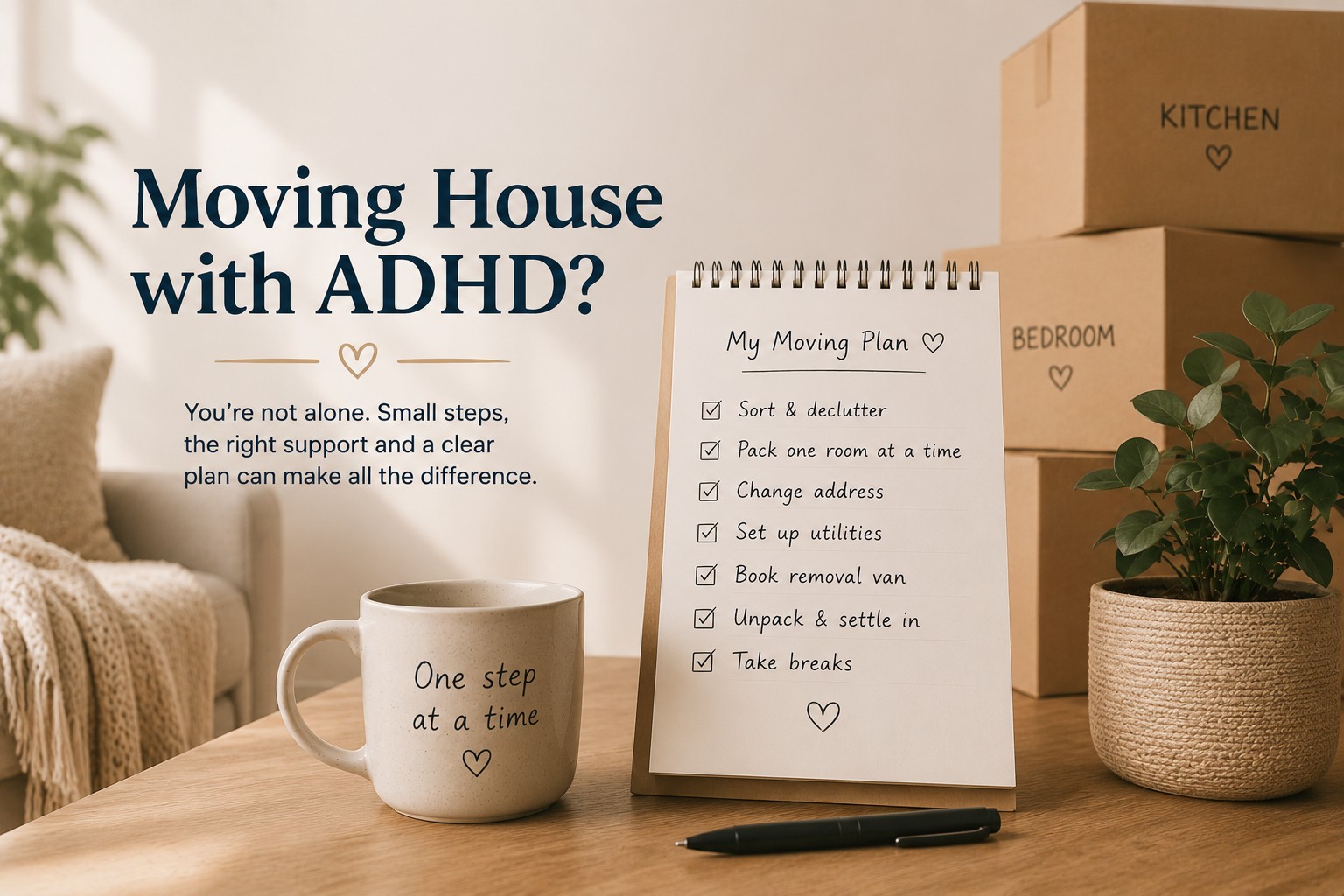
Moving house is often considered one of life's most stressful events. So, it should come as no surprise that for people with ADHD, moving can feel stressful times a hundred.
And no, this is not because people with ADHD are lazy or simply bad at organising. In reality, ADHD affects executive functioning, emotional regulation and decision-making – all of which play a crucial role during a house move (Barkley, 2015; NIMH, 2024).
People with ADHD often experience stress more intensely, especially during major life changes. Understanding why moving feels so overwhelming is the first step towards making the process easier and more manageable.
Why Moving Can Feel Overwhelming When You Have ADHD
Moving house is about much more than packing boxes.
There are countless additional tasks involved: updating your address, notifying important organisations, switching utility providers, decluttering, booking removal companies, organising paperwork and keeping track of deadlines.
All of these tasks require executive functioning skills, which can already be challenging for people with ADHD (Kofler et al., 2019).
Add disrupted routines, uncertainty and the fear of the unknown, and it's easy to see why moving can quickly feel overwhelming.
Executive Dysfunction Makes Every Task Feel Bigger
Executive dysfunction is one of the core challenges associated with ADHD. Unfortunately, moving house requires almost constant use of executive functioning skills.
Difficulty Getting Started
As with many things in life, getting started is often the hardest part. One of the most common questions people with ADHD ask during a move is: "Where do I even begin?" The sheer number of tasks involved can make starting feel impossible.
Planning Can Feel Overwhelming
Some people joke that "the best plan is no plan". However, when it comes to moving house with ADHD, having a clear plan is essential. Without a structured system, important tasks can easily slip through the cracks.
Prioritising Tasks Isn't Always Easy
It's natural to think that packing should be the first priority. But what happens if you leave booking a removal van until the last minute? You may discover that no companies are available or that prices have increased significantly.
Constant Task Switching
Moving often requires switching between multiple tasks throughout the day. You may begin packing the kitchen only to remember that you still need to arrange broadband installation, contact your solicitor or find a handyman. Constantly switching between tasks can be mentally exhausting.
Maintaining Focus Can Be Difficult
Successful moves rarely happen in a single day. Instead, they require small, consistent actions over several weeks. Staying focused and maintaining "moving mode" every day isn't always easy when you have ADHD.
Research suggests that executive functioning difficulties are common in adults with ADHD and can significantly affect planning, organisation and task completion (Barkley, 2015; Kofler et al., 2019).
Decision Fatigue Can Become Exhausting
Moving house involves hundreds of decisions. Some seem small:
Should I keep this item?
Should I donate it?
Do I really need it?
Others feel much bigger:
Which removal company should I choose?
Which energy provider offers the best deal?
Which broadband package is right for my new home?
This constant stream of decisions can become overwhelming.
Research suggests that people with ADHD often expend considerable mental energy on decision-making, which may contribute to decision paralysis and procrastination when faced with too many choices (Brown, 2013). Before you know it, your dream move can start feeling like a nightmare.
Changes in Routine Can Increase Stress
Most people dislike having their daily routines disrupted. For people with ADHD, these disruptions can feel even more significant.
Moving house often involves:
disrupted sleep
changes in eating habits
unfamiliar surroundings
new schedules
uncertainty about the future
Because predictability often helps people with ADHD manage daily life more effectively, losing familiar routines can increase anxiety and stress (NIMH, 2024).
Unfortunately, there is no magic solution. However, preparing for the move in advance can help reduce uncertainty.
You may find it helpful to:
read articles about moving house
speak to friends who have recently moved
research your new neighbourhood
join local community groups before moving
The stress may not disappear entirely, but understanding what to expect can make the transition feel more manageable.
Emotional Overwhelm Is Real
Many people say that emotional exhaustion can feel even harder than physical exhaustion. Physical tiredness can often be resolved with rest. Mental overwhelm is different. People with ADHD frequently experience emotions more intensely. During a move, emotional dysregulation can become particularly noticeable (Shaw et al., 2014).
Common emotions may include:
frustration
irritability
anxiety
guilt
shame
sadness
emotional exhaustion
Many people wonder: "Why can't I cope with this like everyone else?" The truth is that moving house is emotionally demanding for almost everyone. You're not only organising a move. You're also saying goodbye to a familiar environment, leaving your comfort zone and facing uncertainty about the future. As many people in ADHD communities describe it: "Moving feels like trying to manage fifty emergencies at the same time." If moving feels overwhelming, you're certainly not alone.
Stress Can Worsen Executive Function
Have you ever heard of the vicious cycle? Stress can negatively affect executive functioning, which then makes completing tasks even harder. The cycle often looks like this:
Stress → Worse Executive Function → More Unfinished Tasks → More Stress
Studies have shown that stress can impair executive functioning by affecting the prefrontal cortex, making planning, focus and decision-making even more difficult (Arnsten, 2009). In other words, stress creates even more stress. Understanding this cycle is important because it helps explain why moving can suddenly feel completely unmanageable.
What Actually Helps?
Break Tasks Into Tiny Steps- You do not need to do everything at once.
Small steps are often far more effective.
Instead of saying: "Today I'll pack the entire kitchen. “Try: "Today I'll organise one drawer." (And yes, everyone has a junk drawer.)
Reduce the Number of Decisions- Avoid making every decision at once.
Use:
checklists
moving timelines
predefined categories
packing systems
Reducing decision-making helps reduce overwhelm.
Externalise Your Memory- Don't expect yourself to remember everything.
That's exactly why reminders, calendars, checklists and apps exist.
External systems reduce cognitive load and free up mental energy for more important tasks.
Maintain Routines Wherever Possible- Routine is incredibly important for many people with ADHD.
Try to:
maintain regular sleep patterns
eat meals at familiar times
take breaks
stay hydrated
Your body and brain will thank you for it.
Ask for Help- Asking for help is not a sign of weakness.
Quite the opposite.
If you have supportive friends, family members or a partner, don't hesitate to ask for assistance.
Protecting your physical and mental wellbeing is far more important than trying to do everything alone.
Use Tools That Reduce Mental Load
Many people with ADHD find that external systems make moving feel much more manageable. Using moving checklists, timelines, reminders and clearly labelled boxes can reduce cognitive overload and make it easier to stay on track throughout the moving process.
How Movly Can Help Reduce ADHD Moving Overwhelm
When you have ADHD, trying to keep every moving task in your head can quickly become overwhelming.
Many people find that using external systems makes moving significantly easier. Instead of relying on memory alone, structured tools can help reduce mental load and create a sense of predictability throughout the moving process.
Movly was designed to simplify moving by helping you:
break your move down into smaller, manageable tasks
follow a clear moving timeline instead of trying to remember everything at once
set reminders for important deadlines
keep track of address changes and essential admin tasks
organise your belongings using the Scan Box feature
share tasks with your partner or family members
Rather than trying to juggle dozens of moving responsibilities at once, having a clear plan can help reduce overwhelm and make the entire process feel more manageable. Because when you have ADHD, reducing mental load isn't just helpful – it's essential.
Final Thoughts
Moving house can be frightening and overwhelming. However, with the right preparation and understanding, it can become a far more manageable experience. If moving feels unusually hard, you're not failing. ADHD can make moving significantly more demanding because it affects the exact skills a successful move requires. Small steps, external support and structured systems can make the process far more manageable.
If you're looking for practical moving strategies, read our guide: Moving House with ADHD: Practical Ways to Reduce Stress and Stay Organised.
References:
Arnsten, A. F. T. (2009). Stress signalling pathways that impair prefrontal cortex structure and function. Nature Reviews Neuroscience, 10(6), 410-422.
Barkley, R. A. (2015). Attention-Deficit Hyperactivity Disorder: A Handbook for Diagnosis and Treatment (4th ed.). Guilford Press.
Brown, T. E. (2013). A New Understanding of ADHD in Children and Adults: Executive Function Impairments. Routledge.
Kofler, M. J., et al. (2019). Executive functioning heterogeneity in ADHD. Journal of Abnormal Child Psychology, 47, 273-286.
National Institute of Mental Health (2024). Attention-Deficit/Hyperactivity Disorder. National Institutes of Health.
Shaw, P., Stringaris, A., Nigg, J., & Leibenluft, E. (2014). Emotion dysregulation in attention deficit hyperactivity disorder. American Journal of Psychiatry, 171(3), 276-293.
FAQ- Frequently Asked Questions
Why is moving house so difficult with ADHD?
Moving house requires planning, organisation, decision-making and task prioritisation. These are all executive functioning skills that many people with ADHD find challenging, which is why moving can feel particularly overwhelming.
Can moving house make ADHD symptoms worse?
Yes. Stress, disrupted routines and lack of sleep can temporarily worsen ADHD symptoms, making it harder to focus, stay organised and complete tasks.
How can I make moving house easier with ADHD?
Breaking tasks into smaller steps, using checklists, maintaining routines and asking for support can make moving much more manageable.
What is executive dysfunction during a move?
Executive dysfunction refers to difficulties with planning, starting tasks, prioritising and staying organised. During a move, executive dysfunction can make even simple tasks feel overwhelming.
How early should I start preparing for a move if I have ADHD?
Whenever possible, start planning at least 6-8 weeks before moving day. Beginning early allows you to spread tasks over time and reduce last-minute stress.
Are moving checklists helpful for people with ADHD?
Yes. Checklists reduce cognitive load by externalising memory, helping you keep track of important tasks and deadlines without relying solely on your memory.
Why does moving house feel emotionally overwhelming?
Moving often involves major life changes, uncertainty, disrupted routines and leaving familiar environments behind. For people with ADHD, these changes can trigger emotional overwhelm, anxiety and stress.
Can moving apps help people with ADHD stay organised?
Many people find that moving apps, timelines and reminders help reduce mental load, improve organisation and make the moving process feel less overwhelming.