Moving to Sheffield in 2026? A Practical Guide to Living in Sheffield
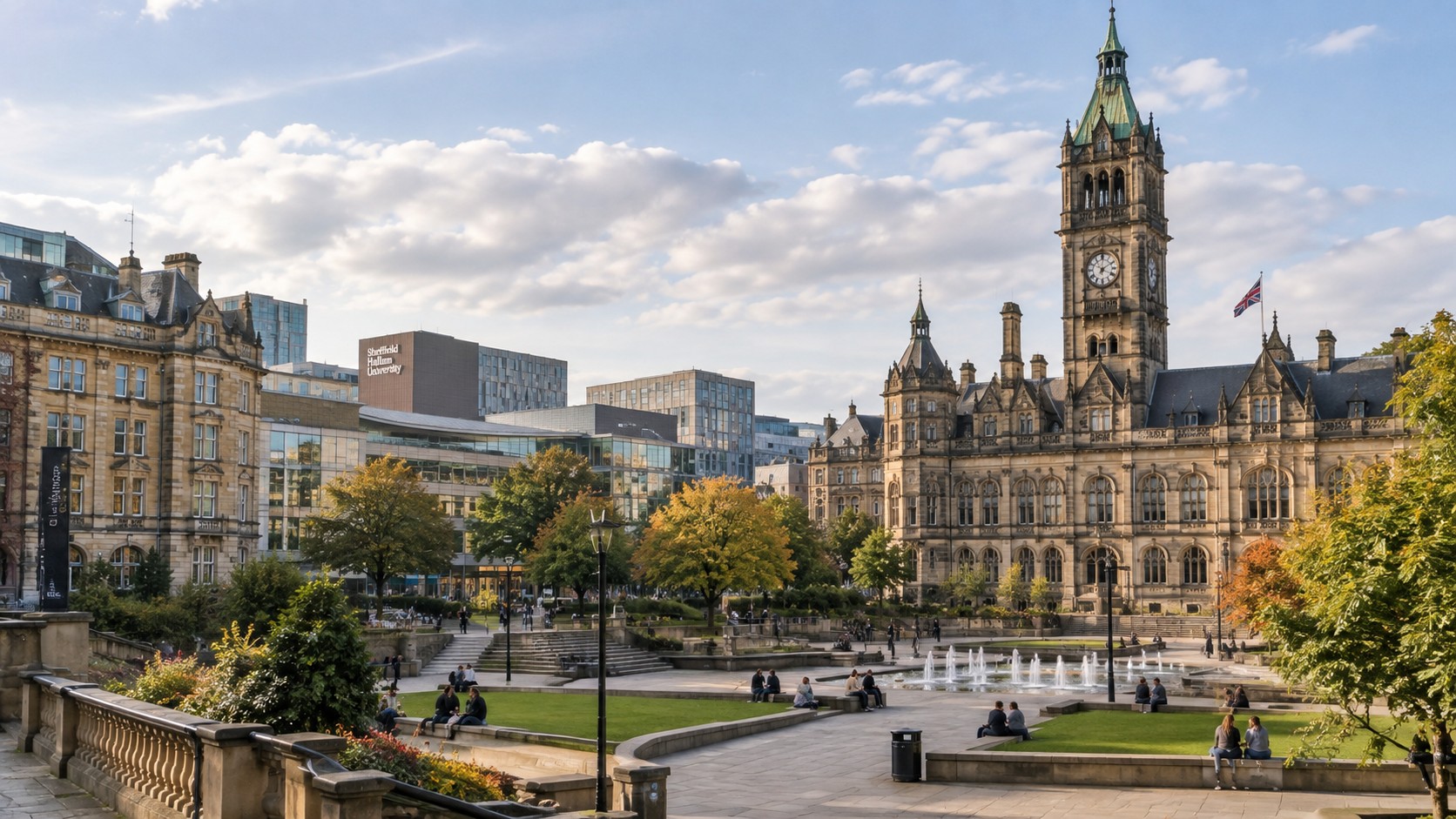
Thinking About Moving to Sheffield?
Sheffield is a large city in South Yorkshire, known for its industrial and steel-making history, universities and unusually easy access to green space. It combines a busy city centre with residential neighbourhoods, parks, woodland and countryside, with part of the city boundary extending into the Peak District National Park.
Where you live can make quite a difference to everyday life. Areas closer to the centre give you easier access to shops, universities, nightlife and public transport, while neighbourhoods further west and south-west put you closer to parks, woodland and the Peak District. Sheffield is also built across hills, so distance on a map doesn't always tell you how easy a journey will actually be.
If you're thinking about moving to Sheffield in 2026, this guide looks at the practical things worth checking before you choose an area or property - including house prices, rent, transport, education, family life, safety, jobs, cost of living and what there actually is to see and do around the city.
Is Sheffield a Good Place to Live?
Sheffield can be a good option if you want the facilities of a large city without being too far from parks, woodland and countryside. One of the things that makes the city different from many other large UK cities is its amount of green space. Sheffield City Council manages hundreds of parks, woodlands and other outdoor spaces, and around a third of the city lies within the Peak District National Park.
The city also has two major universities, a large student population, shopping, restaurants, theatres, music venues and sports facilities. At the same time, areas such as Ecclesall, Crookes, Hillsborough, Walkley and Nether Edge can feel quite different from living in or immediately around the city centre, so Sheffield isn't one place with one type of lifestyle.
Location is particularly important if you're moving here for work or need to commute regularly. Sheffield has rail connections to cities including Manchester, Leeds, Nottingham and London, but journeys within Sheffield can be affected by its hilly landscape and by how close you are to a useful tram or bus route.
There are trade-offs too. Some parts of the city are much better connected than others, and house prices, parking, access to green space and the general feel of an area can change considerably between neighbourhoods. Later in the guide, we'll look at these areas separately rather than treating the whole of Sheffield as if it offers the same experience.
Where Is Sheffield?
Sheffield is in South Yorkshire, in the north of England. It is one of four local authority areas that make up South Yorkshire, alongside Rotherham, Barnsley and Doncaster.
The city sits close to the Derbyshire border, with Rotherham to the north-east and the Peak District immediately to the west. Sheffield's administrative area stretches much further than the city centre and includes suburban neighbourhoods as well as more rural areas on its western side. Some parts of the Sheffield council area even extend into the Peak District National Park.
Sheffield itself is divided into 28 electoral wards, covering very different parts of the city. These include central areas as well as neighbourhoods such as Ecclesall, Crookes and Crosspool, Hillsborough, Walkley, Fulwood, Dore and Totley and Stocksbridge and Upper Don.
This is useful to understand when you're looking for a home, because a Sheffield address can mean anything from a city-centre apartment to a house close to woodland and the edge of the Peak District. Later in the guide, we'll look more closely at the individual areas and postcodes rather than treating Sheffield as one single housing market.
Transport & Commuting
Sheffield has a mix of trains, trams and buses, but how easy your daily journey is will depend quite a lot on the neighbourhood you choose.
Sheffield railway station is the city's main station and has direct services to a number of major UK cities. National Rail lists direct connections including London St Pancras, Manchester, Leeds, Liverpool and Bristol. The fastest journeys are around 42 minutes to Leeds, 53 minutes to Manchester and just under two hours to London, although actual journey times depend on the service (National Rail, 2026).
Within Sheffield, the Supertram network is an important part of public transport, alongside local buses. This can make living near a tram route particularly useful if you need regular access to the city centre, universities or other parts of Sheffield. The city is also investing in improvements to its tram, bus and wider transport network, with further expansion and upgrades planned over the coming years (Sheffield City Council, 2026).
One thing worth remembering is that Sheffield is a hilly city. A property that looks close to the city centre, station or university on a map may not necessarily mean an easy walk, so it's worth checking the actual route as well as the distance.
For drivers, location matters too. If you'll be commuting outside Sheffield regularly, check your route from the exact property rather than simply looking at its distance from the city centre. Traffic, parking and access to the main roads can vary considerably between neighbourhoods.
💙 Movly tip: Before choosing a property, check what's actually around the address. With Movly Local Insights, you can explore nearby transport, schools, shops, healthcare, parks, restaurants, gyms and more, with distances from the property shown in one place.
House Prices in Sheffield
House prices in Sheffield vary quite a lot depending on the type of property and the part of the city you're looking at.
According to the latest ONS data, the average house price in Sheffield was around £220,000 in July 2026, up 2.8% from around £214,000 a year earlier (ONS, 2026). These figures cover the Sheffield local authority area rather than one particular postcode or neighbourhood.
There is also a noticeable difference between property types. In July 2026, the average price was around £384,000 for a detached property, £240,000 for a semi-detached home, £199,000 for a terraced property and £134,000 for a flat or maisonette (ONS, 2026).
The city-wide average only tells you part of the story. Sheffield includes city-centre apartments, traditional terraced streets and larger family homes further from the centre, so prices can look quite different depending on the neighbourhood you're considering.
When comparing properties, it's worth checking recent sold prices around the actual street or postcode rather than relying only on the Sheffield average. We'll look more closely at some of the individual areas later in the guide.
💙 Movly tip: Sheffield's city-wide average can hide big differences between postcodes. With Movly Area Guides, you can check house prices for individual Sheffield postcodes, including median and average prices, recent sales and a breakdown by property type.
Renting in Sheffield
Sheffield has a large private rental market, with options ranging from city-centre flats and student accommodation to terraced houses and larger family homes in residential neighbourhoods.
According to the latest ONS data, the average private rent in Sheffield was £931 per month in August 2026, up from £893 a year earlier. That's an annual increase of 4.3% (ONS, 2026). These figures cover the Sheffield local authority area rather than one particular postcode.
The amount you'll pay depends considerably on the size of the property. In August 2026, average monthly rents in Sheffield were £690 for a one-bedroom property, £840 for two bedrooms, £967 for three bedrooms and £1,339 for four or more bedrooms (ONS, 2026).
Property type makes a difference too. Average rents were £774 for flats and maisonettes, £923 for terraced properties, £990 for semi-detached homes and £1,233 for detached properties (ONS, 2026).
As with house prices, a Sheffield-wide figure won't tell you exactly what you'll pay in a particular neighbourhood. Before choosing a rental, compare current listings in the specific area you're considering and check what is included in the rent, particularly if you're comparing student accommodation or shared properties.
Popular Areas in Sheffield
Sheffield has a wide range of neighbourhoods, and the right area will depend on whether you want to be closer to the city centre, universities, public transport or Sheffield's parks and western edge. These are some of the areas you're likely to come across when looking for a home:
Ecclesall & Sharrow Vale – Close to Ecclesall Road, with plenty of restaurants, cafés, shops and pubs nearby. Endcliffe Park and the Botanical Gardens are also close, while the area is popular with both local residents and students (Welcome to Sheffield, 2026).
Crookes & Broomhill – Both sit west of the city centre and have strong student populations because of their proximity to the universities. You'll also find independent shops, cafés and local businesses, with Crookes sitting noticeably higher up the hill than the city centre (University of Sheffield, 2026).
Walkley – Another hillside neighbourhood west of the centre, close to Crookes and Hillsborough. It's mainly residential but still gives you access to local shops and services, and it's worth checking the exact route if you'll regularly be travelling into the centre because Sheffield's hills can make a difference to everyday journeys.
Hillsborough – North-west of the city centre, with its own shops and independent businesses and good access to public transport. It can be useful to consider if you want to live outside the centre while still having local amenities nearby (Welcome to Sheffield, 2026).
Nether Edge – Around two to three miles south-west of the city centre. Parts of the neighbourhood are within the Nether Edge Conservation Area, known for tree-lined streets and a mixture of Victorian and Edwardian villas, terraces and semi-detached homes (Sheffield City Council, 2026).
Kelham Island & Neepsend – Close to the city centre and shaped heavily by Sheffield's industrial history. Kelham Island is one of Sheffield's historic industrial areas, with former workshops and metal-trade buildings alongside newer apartments, restaurants and independent businesses (Sheffield City Council, 2026).
Dore, Totley & Fulwood – On Sheffield's south-western and western side, these areas put you closer to the rural edge of the city and routes towards the Peak District. They're quite different from living centrally, so they're worth considering if access to countryside is higher on your list than being close to the city centre.
Rather than choosing an area based only on its name or reputation, check the exact street and postcode. Even neighbouring parts of Sheffield can differ in property prices, transport, services and access to green space.
💙 Movly tip: If you're choosing between different parts of Sheffield, Movly Area Guides let you compare individual postcode areas side by side. You can compare things such as house prices, crime, broadband and green space, then open a postcode for a more detailed look at local housing, schools, transport, services and more.
Sheffield Postcodes
Sheffield uses the S postcode area, with different postcode districts covering the city centre, suburbs and communities further from central Sheffield. However, the wider S postcode area extends well beyond Sheffield, and some postcode districts around the edge of the city also cross local authority boundaries.
Postcode boundaries don't always match neighbourhood or council boundaries exactly. Sheffield City Council specifically notes that postcode boundaries do not align with council areas, so a Sheffield postcode should not automatically be treated as meaning that an address is within the Sheffield City Council boundary (Sheffield City Council, 2026).
When you're comparing properties, check the full postcode and address rather than relying only on the first part of the postcode. This will give you a more accurate picture when checking things such as local services, transport and school catchment areas.
Moving to Sheffield with Children
Sheffield has plenty for families to do outside school, particularly if you enjoy spending time outdoors. The city has parks and green spaces across different neighbourhoods, including Endcliffe Park, Graves Park and Animal Farm, Hillsborough Park, Rivelin Valley Park and Ecclesall Woods (Sheffield City Council, 2026).
For younger children and parents looking for local activities and support, Sheffield has a network of Family Hubs. They run free regular activities including baby and toddler groups, walk-and-talk sessions and parenting workshops, as well as providing advice and support for families (Sheffield City Council, 2026).
Childcare options across Sheffield include nurseries, childminders, breakfast and after-school clubs and holiday clubs. During school holidays, eligible children receiving targeted free school meals can also access funded activities through Sheffield's Holiday Activities and Food programme, with sessions including sports, arts, trips and other activities (Sheffield City Council, 2026).
If you're moving to Sheffield with children, it's worth checking what everyday family life would look like from the specific property you're considering. Look at childcare availability, the journey to school, nearby parks and activities, public transport and the services your family would use regularly. We'll look at Sheffield's schools, colleges and universities separately in the next section.
💙 Movly tip: Moving house with children can mean even more things to organise. With Movly, you can share your moving checklist with your partner, so you can split tasks, see what’s already been done and keep track of what still needs doing - all in one place.
Education in Sheffield
For families with younger children, Sheffield has a range of childcare options including nurseries, pre-schools and registered childminders. Sheffield City Council provides information about local childcare and funded early learning, so it's worth checking availability close to the specific area you're considering (Sheffield City Council, 2026).
Sheffield also has primary and secondary schools across the city. If schools are an important part of your move, check them at address level rather than choosing a property based only on the neighbourhood. Sheffield City Council provides catchment information, but school admissions can also depend on individual admission arrangements and whether a school is oversubscribed (Sheffield City Council, 2026).
This is particularly important if you're moving to Sheffield with a child who is already at school. The Council treats applications made outside the normal point of entry as in-year applications, including applications from families who are new or returning to Sheffield (Sheffield City Council, 2026).
For older students, Sheffield has sixth-form and further education options. The Sheffield Sixth Form, based at The Sheffield College's City Campus, offers A Levels, while The Sheffield College also provides vocational courses, T Levels, apprenticeships and courses for adults (The Sheffield College, 2026).
Sheffield is also home to two major universities. The University of Sheffield is a member of the Russell Group, with its main campus on the western edge of the city centre. Sheffield Hallam University has its main City Campus opposite Sheffield railway station as well as its Collegiate Campus around Collegiate Crescent (University of Sheffield, 2026; Sheffield Hallam University, 2026).
Before committing to a property, families should check the latest school admissions information, catchment area and availability where relevant. Students moving to Sheffield for university should also check where their course is based before choosing accommodation, as the location can make a noticeable difference to their everyday journey.
💙 Movly tip: With Movly Area Guides, you can check schools near the area you're considering, including their latest Ofsted ratings, helping you compare your options before choosing where to live.
Is Sheffield a Safe Place to Live?
Safety can vary between different parts of Sheffield, so it's more useful to look at the specific neighbourhood you're considering rather than relying on one figure for the whole city.
South Yorkshire Police divides Sheffield into several neighbourhood policing areas, including the City Centre, North East, North West and South West. Each has its own local crime information and priorities, allowing you to look more closely at the part of Sheffield you're considering (South Yorkshire Police, 2026).
The city centre naturally needs some additional context because of the number of people who work, shop and spend time there. In July 2026, the most commonly reported crime categories in the Sheffield City Centre policing area were violence and sexual offences, anti-social behaviour, shoplifting and public order offences (South Yorkshire Police, 2026).
For anyone moving to Sheffield, the most useful approach is to check recent crime information around the actual property. South Yorkshire Police provides local crime maps where you can search individual neighbourhoods and see reported incidents around particular streets and areas (South Yorkshire Police, 2026).
💙 Movly tip: With Movly Area Guides, you can check detailed crime statistics for the postcode you're considering, see how crime levels compare with the national average and explore a breakdown by crime type - all before choosing your new area.
Local Life & Things to Do in Sheffield
Sheffield has a mix of museums, cultural venues, historic buildings, independent businesses and city-centre attractions, so there is plenty to explore beyond the neighbourhood you live in.
In the city centre, the Millennium Gallery focuses on art, design and Sheffield's metalworking heritage, including the city's Metalwork Collection and the Ruskin Collection. It sits next to the Winter Garden, one of the city's best-known indoor public spaces, and close to the Peace Gardens (Sheffield Museums, 2026).
Sheffield's industrial history is particularly visible around Kelham Island. The Kelham Island Museum explores the city's history of making and manufacturing, while the surrounding neighbourhood has developed into an area with independent restaurants, pubs and businesses (Sheffield Museums, 2026).
For a different part of Sheffield's history, Sheffield Cathedral stands in the city centre on a site associated with Christian worship for more than 1,000 years. The present building includes elements dating back to the medieval parish church, and it became a cathedral in 1914 (Sheffield Cathedral, 2026).
There are also theatres, galleries, markets, restaurants and events across the city, so what is easiest to access will depend on where in Sheffield you live. When comparing areas, it's worth looking at the places you would actually use regularly rather than simply how far the property is from the city centre.
Healthcare in Sheffield
Sheffield has GP surgeries, pharmacies and a number of major hospital services across the city. If you're moving to a new area, you can use the NHS Find a GP service to search by postcode and find practices near your new address. Most people register with a surgery close to where they live, although some practices accept patients from outside their immediate area (NHS, 2026).
Hospital care is provided by Sheffield Teaching Hospitals NHS Foundation Trust, which runs several sites across the city, including Northern General Hospital, Royal Hallamshire Hospital, Jessop Wing, Weston Park Cancer Hospital and Charles Clifford Dental Hospital (NHS, 2026).
Northern General Hospital, on Herries Road, is home to Sheffield's adult Accident & Emergency department and provides a range of acute and specialist services. Royal Hallamshire Hospital is another major teaching hospital in the city, with a wide range of outpatient and specialist services (Sheffield Teaching Hospitals, 2026).
If healthcare access is particularly important for your move, check the distance from the actual property to your GP, pharmacy and relevant hospital services. Sheffield is a large city, so the most convenient healthcare options can differ considerably depending on where you live.
Green Spaces & Outdoors
Green space is a big part of life in Sheffield. The city has parks, woodlands and nature reserves spread across different neighbourhoods, including Endcliffe Park, Graves Park, Rivelin Valley Park, Sheffield Botanical Gardens and Weston Park (Sheffield City Council, 2026).
Ecclesall Woods is particularly notable. Sheffield City Council describes it as the largest ancient semi-natural woodland in South Yorkshire, with more than 15 km of public footpaths running through the woods (Sheffield City Council, 2026).
There are also plenty of options for longer walks. The approximately 14-mile Sheffield Round Walk starts at Endcliffe Park and passes through the Porter Valley, Ecclesall Woods, Graves Park and several other green spaces before returning to Endcliffe Park (Sheffield City Council, 2026).
One of Sheffield's biggest advantages for people who enjoy the outdoors is its access to the countryside around the city and the Peak District. Sheffield City Council identifies numerous areas of open countryside around Sheffield and the Peak District where public access is available for activities such as walking and sightseeing (Sheffield City Council, 2026).
If outdoor space matters to you, it's worth checking what's close to the particular neighbourhood you're considering. Living near one of Sheffield's parks, woodland areas or walking routes can give you very different options from one part of the city to another.
Jobs & Working in Sheffield
Sheffield has employment across a broad mix of sectors, including healthcare, education, retail, professional services, manufacturing, technology and the creative industries. Health, education, retail and other everyday services together account for a large proportion of jobs in the city (Sheffield City Council, 2025).
The city also continues to have a strong connection with advanced manufacturing and engineering. Sheffield's current Growth Plan identifies advanced manufacturing, health and wellbeing, technology, creative industries and professional and business services among the specialist sectors important to the city's economy (Sheffield City Council, 2025).
The latest labour market data for April 2025 to March 2026 estimates that around 287,200 Sheffield residents aged 16 and over were in employment, with professional occupations representing the largest individual occupational group (ONS/Nomis, 2026).
Sheffield's two universities, healthcare system and large public-sector organisations also contribute to the local employment market, while the city's technology and advanced manufacturing sectors provide opportunities in more specialised fields.
If you're moving to Sheffield for work, check the journey from the actual neighbourhood you're considering rather than looking only at its distance from the city centre. Where you work can make a significant difference to which part of Sheffield is most practical for your daily commute.
Cost of Living in Sheffield
The cost of living in Sheffield will depend largely on your housing costs, the area you choose and how you travel day to day.
Housing is likely to be one of the biggest monthly expenses. The average private rent in Sheffield was £931 per month in August 2026, up from £893 a year earlier. Average rents were £690 for a one-bedroom property, £840 for two bedrooms, £967 for three bedrooms and £1,339 for homes with four or more bedrooms (ONS, 2026).
Council Tax is another cost to include in your budget. For 2026/27, standard Council Tax charges in Sheffield range from £1,670.22 for Band A to £5,010.65 for Band H, with a Band D property charged £2,505.32. Some areas covered by parish or town councils have additional charges (Sheffield City Council, 2026).
Energy costs will depend on the property, tariff and how much energy you use. From 1 October to 31 December 2026, Ofgem's energy price cap for a typical household on a default tariff paying by Direct Debit will be £1,723 per year. This is not a maximum household bill, as the amount you actually pay still depends on your energy use (Ofgem, 2026).
When comparing properties in Sheffield, look beyond the rent or mortgage payment. Council Tax, energy, water, broadband, parking and commuting costs can all make a noticeable difference to your monthly budget.
💙 Movly tip: Moving home is a good time to review your household bills. With Movly, you can compare and switch utilities and broadband for your new home, helping you find options that suit your needs and budget.
Population & Local Community
Sheffield had a population of around 556,500 at the 2021 Census, an increase of 0.7% from around 552,700 in 2011. The city had approximately 232,000 households at the time of the latest Census (ONS; Sheffield City Council, 2021).
Sheffield also has a relatively young population. The median age was 37 in 2021, compared with 40 across England, and Sheffield City Council notes that the city has a particularly large number of people aged 20–24 because of its significant student population (ONS; Sheffield City Council, 2021).
The city is home to a varied population. In the 2021 Census, 79.1% of residents identified within the White ethnic group, 9.6% within Asian, Asian British or Asian Welsh groups, 4.6% within Black, Black British, Black Welsh, Caribbean or African groups, and 3.5% within Mixed or Multiple ethnic groups (ONS, 2021).
As with housing, transport and local services, Sheffield can feel quite different from one neighbourhood to another. If you're deciding where to live, local statistics for the particular area or postcode you're considering can be more useful than city-wide figures alone.
Your Moving to Sheffield Checklist
Once you've chosen where in Sheffield you want to live, starting early can make the final few weeks before your move much easier.
8 weeks before: create your moving budget, start decluttering, organise important documents, get packing supplies and book your removal company or van. If needed, check parking arrangements at both properties and organise storage.
2–3 weeks before: notify Council Tax, arrange your Royal Mail redirection, update your driving licence and start setting up broadband for your new address. This is also a good time to arrange childcare or pet care for moving day and schedule any final cleaning.
1 week before: update your bank, insurance and TV Licence, confirm arrangements with your movers, finish packing and prepare a separate box or bag with essentials such as toiletries, chargers and a change of clothes.
Moving day: photograph your gas and electricity meter readings at both properties, complete a final walkthrough, hand over and collect your keys and make sure nothing has been left behind. Renters should also photograph the condition of the property they are leaving.
After the move: unpack your essentials first, register with a local GP and dentist, check smoke and carbon monoxide alarms, locate the fuse box, water shut-off and boiler controls, set up your bin collection schedule and make sure your broadband is working.
💙 Movly tip: This is only a snapshot of the full checklist. Movly gives you a personalised 8- weeks moving timeline with tasks for each stage of your move, including additional steps for buyers and renters. You can add your own tasks, set reminders and share your checklist with your partner.
Final Thoughts
Sheffield can offer very different day-to-day experiences depending on where in the city you choose to live. You could be close to the city centre and universities, in an established residential neighbourhood such as Crookes or Ecclesall, or further out with easier access to green spaces and the countryside.
Before choosing a property, look beyond the asking price or monthly rent. Check the full postcode, transport, school options if you need them, local crime data, Council Tax and the everyday services around the actual address. In a large city like Sheffield, the neighbourhood you choose can make a noticeable difference to your commute and daily routine.
Sheffield's combination of employment, universities, local amenities and extensive green space gives people plenty to consider when deciding whether the city suits their move. Its location next to the Peak District is also particularly useful if access to the outdoors is important to you.
If Sheffield feels right for your move, getting organised early can make the process much easier. And with Movly, you can manage everything from researching your new area and following your personalised moving checklist to organising utilities, packing and moving day - all in one place.
Frequently Asked Questions About Moving to Sheffield
Is Sheffield a good place to live?
Sheffield can work well if you want the amenities of a large city while still having easy access to parks, woodland and the countryside. It has universities, employment across a range of sectors, public transport and distinct residential neighbourhoods, so the experience of living here can vary depending on the area you choose.
How much does a house cost in Sheffield?
According to the latest ONS data used in this guide, the average house price in Sheffield was around £220,000 in July 2026. Prices vary by property type and area, so recent sold prices around the specific postcode you're considering will give you a more useful comparison (ONS, 2026).
How much does it cost to rent in Sheffield?
The average private rent in Sheffield was £931 per month in August 2026. One-bedroom properties averaged £690 per month, while two-bedroom properties averaged £840 and three-bedroom properties £967 (ONS, 2026).
What are some popular areas to live in Sheffield?
Areas commonly considered when moving to Sheffield include Crookes, Walkley, Hillsborough, Ecclesall, Nether Edge, Kelham Island and Dore. They differ in housing, transport, access to the city centre and nearby green spaces, so the right area depends on what you need day to day.
What postcodes cover Sheffield?
Sheffield mainly uses the S postcode area, although the wider S postcode area extends beyond the city. Postcode boundaries don't always match neighbourhood or council boundaries, so it's worth checking the full address when researching a property.
Is Sheffield good for families?
Sheffield has childcare, schools, Family Hubs, parks and activities for children across the city. Families should check school admissions, childcare availability and everyday journeys from the specific address they're considering rather than relying only on the neighbourhood name.
Is Sheffield safe?
Crime levels and the types of incidents reported vary between different parts of Sheffield. Rather than relying on one city-wide figure, check recent South Yorkshire Police crime data around the particular street or postcode you're considering.
Does Sheffield have good access to the Peak District?
Yes. Sheffield sits next to the Peak District National Park and has access to countryside and walking routes on the western side of the city. How easy it is to reach these areas will depend on where in Sheffield you live and whether you're travelling by car or public transport.
Do I need a car to live in Sheffield?
Not necessarily. Sheffield has bus, tram and rail services, and some neighbourhoods have shops and everyday services within walking distance. Whether you need a car will depend on where you live, where you work and how often you travel outside your local area.
Does Sheffield have universities?
Yes. Sheffield is home to the University of Sheffield and Sheffield Hallam University, both of which have major campuses in and around the city centre.
References:
Sheffield City Council
Sheffield electoral wards and local boundaries
https://www.sheffield.gov.uk/your-city-council/elections/electoral-wards
Sheffield City Council
Public transport in Sheffield
https://www.sheffield.gov.uk/travel-transport/public-transport
National Rail
Sheffield rail connections and journey times
https://www.nationalrail.co.uk/discover-by-train/great-british-destinations/visit-sheffield-by-train/
Office for National Statistics (ONS)
Housing prices and private rents in Sheffield
https://www.ons.gov.uk/visualisations/housingpriceslocal/E08000039/
Sheffield City Council
Street Naming and Numbering – Sheffield addresses and postcodes
https://www.sheffield.gov.uk/roads-pavements/apply-for-street-naming-and-numbering
Sheffield City Council
Family Hubs and parenting support
https://www.sheffield.gov.uk/young-people-families/family-parent-hubs
Sheffield City Council
Family Hub activities and groups
https://www.sheffield.gov.uk/young-people-families/family-parent-hubs/events-groups
Sheffield City Council
Childcare provision in Sheffield
https://www.sheffield.gov.uk/schools-childcare/childcare-provision-in-sheffield
Sheffield City Council
School admissions in Sheffield
https://www.sheffield.gov.uk/schools-childcare/admissions/how-apply-school-sheffield
Sheffield City Council
School catchment areas
https://www.sheffield.gov.uk/schools-childcare/admissions/school-catchment-areas
The Sheffield Sixth Form / The Sheffield College
A Levels and sixth-form study at City Campus
https://sixthform.sheffcol.ac.uk/about
The Sheffield College
A Levels, apprenticeships, T Levels and vocational study
https://www.sheffcol.ac.uk/
University of Sheffield
University information and campus
https://www.sheffield.ac.uk/
University of Sheffield
Russell Group membership and university information
https://www.sheffield.ac.uk/about/rankings
Sheffield Hallam University
City Campus and Collegiate Campus
https://www.shu.ac.uk/study-here/studying-with-us/our-campuses
Sheffield Hallam University
Campus locations and travel information
https://www.shu.ac.uk/visit-us/how-to-find-us
South Yorkshire Police
Sheffield City Centre neighbourhood policing and local crime map
https://www.southyorkshire.police.uk/area/your-area/south-yorkshire/sheffield/sheffield-city-centre/news/crime-map
Sheffield Museums
Millennium Gallery
https://www.sheffieldmuseums.org.uk/visit-us/millennium-gallery/
Sheffield Museums
Kelham Island Museum and Sheffield's industrial heritage
https://www.sheffieldmuseums.org.uk/visit-us/kelham-island-museum/
Sheffield Cathedral
History and heritage of Sheffield Cathedral
https://www.sheffieldcathedral.org/heritage
NHS
Find a GP
https://www.nhs.uk/service-search/find-a-gp
Sheffield Teaching Hospitals NHS Foundation Trust
Hospitals and healthcare services in Sheffield
https://www.sth.nhs.uk/
Sheffield City Council
Parks and green spaces in Sheffield
https://www.sheffield.gov.uk/parks-sport-recreation/parks-gardens/parks-green-spaces
Sheffield City Council
Ecclesall Woods
https://www.sheffield.gov.uk/parks-sport-recreation/parks-gardens/ecclesall-woods
Sheffield City Council
Walking in Sheffield and the Sheffield Round Walk
https://www.sheffield.gov.uk/parks-sport-recreation/physical-activity-outdoor-sport/walking-sheffield
Sheffield City Council
Access Land around Sheffield and the Peak District
https://www.sheffield.gov.uk/roads-pavements/access-land
Sheffield City Council
Sheffield Growth Plan 2025–2035
https://www.sheffield.gov.uk/your-city-council/plans-policies-performance/sheffield-growth-plan-2025-2035
Nomis / Office for National Statistics
Sheffield Labour Market Profile
https://www.nomisweb.co.uk/reports/lmp/lad/1778385142/report.aspx
Sheffield City Council
Council Tax bands and charges for 2026/27
https://www.sheffield.gov.uk/council-tax/your-bill/check-council-tax-band
Ofgem
Energy Price Cap – rates from 1 October to 31 December 2026
https://www.ofgem.gov.uk/your-energy-supply/your-energy-bill/energy-price-cap-unit-rates-and-standing-charges
Office for National Statistics (ONS)
How life has changed in Sheffield – Census 2021
https://www.ons.gov.uk/visualisations/censusareachanges/E08000019
Office for National Statistics (ONS)
Sheffield population change – Census 2021
https://www.ons.gov.uk/visualisations/censuspopulationchange/E08000019/
Royal Mail
Mail Redirection guidance when moving home
Royal Mail – Redirection Help Centre
Disclaimer
The information in this guide is provided for general informational purposes and was accurate to the best of our knowledge at the time of writing. Property prices, rental costs, Council Tax rates, transport services and local amenities may change over time. We recommend checking the latest information with official sources before making any decisions about your move.