Moving to Hertford in 2026? A Practical Guide to Living in Hertford
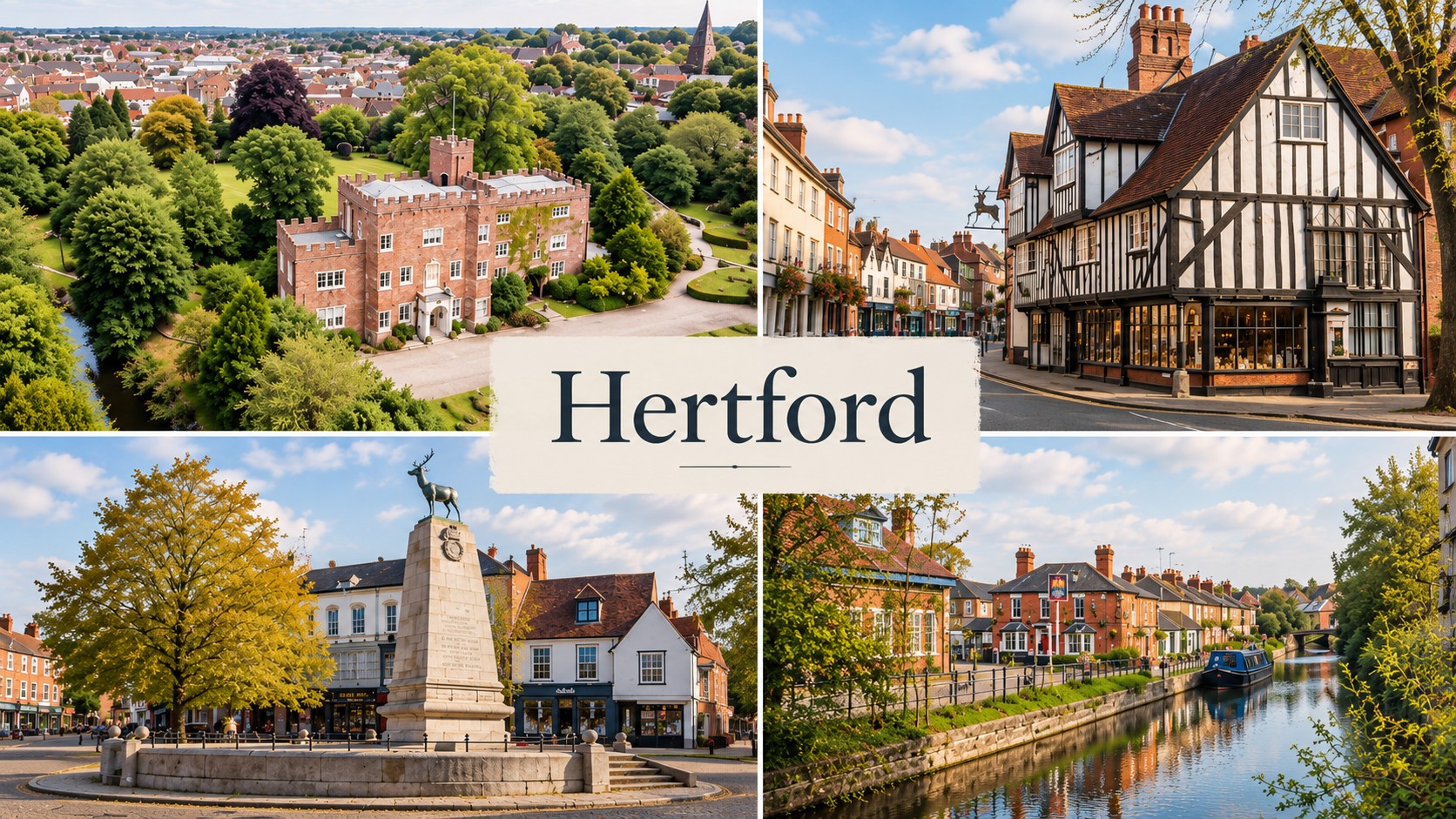
Thinking About Moving to Hertford?
If you’re thinking about moving to Hertford, you’ll find a historic market town with a compact centre, established residential neighbourhoods and easy access to the Hertfordshire countryside. Hertford is the county town of Hertfordshire and is located around 25 miles north of London (East Herts District Council, 2026).
Hertford itself has a population of around 29,400, making it one of the larger towns in East Hertfordshire. The wider East Hertfordshire district had a population of around 150,200 at the 2021 Census, up from just under 137,700 in 2011 (ONS, 2023).
The town combines an historic centre with residential areas such as Bengeo, Kingsmead and Sele. Its location also gives residents access to surrounding countryside while retaining rail connections towards London and road links via the A10 and A414 (East Herts District Council, 2026).
This guide covers the practical things to know before moving to Hertford in 2026, including house prices, rent, popular areas, transport and commuting, schools, safety, local life and the cost of living.
Where Is Hertford?
Hertford is in eastern Hertfordshire, around 25 miles north of central London, and is the county town of Hertfordshire. It lies within the East Hertfordshire district, with Ware immediately to the east and towns such as Welwyn Garden City, Stevenage and Bishop’s Stortford within the wider surrounding area (East Herts District Council, 2026).
The town has a distinctive natural setting, having developed around the meeting point of the Rivers Lea, Beane, Mimram and Rib. These waterways have played an important role in Hertford’s history and continue to shape the town today, with riverside routes and green spaces extending close to the historic centre (East Herts District Council, 2026).
Hertford is connected by road via the A414, providing links towards Hatfield and the A1(M) to the west and Harlow to the east. The nearby A10 provides connections south towards the M25 and north towards Cambridge. The town also has two railway stations - Hertford East and Hertford North - providing separate rail routes towards London.
Although Hertford is within commuting distance of the capital, it has a distinct identity of its own. Its historic centre, rivers, established residential neighbourhoods and surrounding countryside give it the feel of a traditional Hertfordshire market town rather than an outer London suburb.
Is Hertford a Good Place to Live?
Whether Hertford is a good place to live will depend on your priorities, but one of the town’s most distinctive features is its character. Hertford has retained much of its medieval town centre, with historic streets, older buildings and Hertford Castle giving the centre a noticeably different feel from a more modern commuter town. The historic core forms part of a designated conservation area, reflecting its architectural and historic importance (East Herts District Council, 2026).
The setting also contributes to Hertford’s character. The town developed around the confluence of four rivers - the Lea, Beane, Mimram and Rib - and green spaces and river corridors extend unusually close to the centre. Hertford Castle Gardens, Hartham Common and riverside routes mean that historic streets, water and open space are all part of the town rather than being confined to its outskirts (East Herts District Council, 2026).
Despite its historic appearance, Hertford functions as a modern town with shops, cafés, restaurants, leisure facilities and independent businesses. It also retains its traditional market-town role, with a Saturday market and a monthly farmers’ and crafters’ market (East Herts District Council, 2026).
For people who need to travel into London, Hertford also combines this older town setting with rail connections towards the capital and road access via the A10 and A414. This combination of historic architecture, rivers and green space with practical commuter connections is one of the features that distinguishes Hertford from many newer towns around London.
Transport & Commuting
Hertford has an unusual advantage for a town of its size: it has two railway stations on separate routes into London. Hertford East is served by Greater Anglia, with direct trains to London Liverpool Street, while Hertford North is served by Great Northern, with direct services towards London Moorgate. This gives commuters more than one option depending on where they live in the town and where they need to travel in London (Greater Anglia, 2026; Great Northern, 2026).
From Hertford East, direct journeys to London Liverpool Street typically take around 50 minutes, with services also calling at destinations including Ware, Broxbourne and Tottenham Hale. Tottenham Hale provides an interchange with the Victoria line, which can be useful for journeys to other parts of London (Greater Anglia, 2026).
From Hertford North, direct trains towards London Moorgate generally take around 50-55 minutes, travelling via stations including Enfield Chase, Finsbury Park and Highbury & Islington. The two stations are on different sides of Hertford, so the most convenient route can depend significantly on the location of your property (Great Northern, 2026).
By road, the A414 runs through Hertford and provides connections towards Hatfield and the A1(M) to the west and Harlow to the east. The A10 runs nearby, providing connections south towards the M25 and north towards Cambridge. Local bus services also connect Hertford with surrounding towns and villages.
If commuting is an important part of your move, it is worth comparing the journey from the actual property to both Hertford East and Hertford North. A home that appears slightly further from the town centre may still offer a more convenient commute depending on which railway line works better for your destination.
House Prices in Hertford
House prices in Hertford are relatively high compared with many parts of England, reflecting its location within commuting distance of London and the wider housing market in East Hertfordshire. Because official ONS house-price statistics are published for the East Hertfordshire local authority area rather than Hertford town itself, district-level figures provide the most reliable benchmark for the area.
The average house price in East Hertfordshire was £457,000 in July 2026, according to provisional ONS data. This was up from £441,000 in July 2025, representing an annual increase of 3.7% (ONS, 2026).
Prices vary considerably by property type. In July 2026, the average detached property in East Hertfordshire cost £886,000, compared with £527,000 for a semi-detached home, £416,000 for a terraced property and £250,000 for a flat or maisonette (ONS, 2026).
There is also a difference between buyer types. First-time buyers paid an average of £358,000, while home-movers paid around £564,000. These figures cover the whole East Hertfordshire district, so they should not be treated as the expected price for every property in Hertford itself (ONS, 2026).
Within Hertford, prices can vary depending on the type and age of the property, its location and access to either Hertford East or Hertford North station. The town also has a particularly varied housing stock, from older homes close to its historic centre to established residential streets and more recent developments.
💙 Movly tip: If you’re comparing two properties in Hertford, Movly’s Area Guide lets you compare their postcodes side by side, including Council Tax, crime, schools and broadband information. This can help you look beyond the asking price when deciding which location works better for your move.
Renting in Hertford
Official rental statistics are published for the wider East Hertfordshire local authority area, rather than Hertford town alone, so these figures are best used as a benchmark when planning a move.
The average private rent in East Hertfordshire was £1,533 per month in August 2026, up from £1,480 a year earlier. This represents an annual increase of 3.5% (ONS, 2026).
Rental costs vary depending on the size of the property. In August 2026, the average monthly rent was £1,086 for a one-bedroom property, £1,382 for two bedrooms, £1,673 for three bedrooms and £2,449 for properties with four or more bedrooms (ONS, 2026).
There are also differences by property type. The average monthly rent was £1,255 for a flat or maisonette, £1,423 for a terraced property, £1,661 for a semi-detached home and £2,156 for a detached property (ONS, 2026).
Within Hertford itself, location can make a practical difference as well as the monthly rent. If you rely on public transport, it is worth checking whether a property is better placed for Hertford East or Hertford North, as the two stations serve different routes towards London. Older properties around the historic parts of Hertford can also offer a very different type of home from newer developments elsewhere in the town.
Popular Areas in Hertford
Hertford is relatively compact, but its residential areas have noticeably different settings. Some put you close to the historic town centre and railway stations, while others offer quieter residential streets, newer housing or easier access to surrounding countryside.
Bengeo, to the north of the town centre, is one of Hertford’s established residential areas. It includes a mixture of older properties and later development, with local shops, schools and access to open countryside towards the northern edge of the town.
Sele Farm lies to the north-west of central Hertford and has a different character again, with a mixture of housing, local facilities and green space. Its position can also make Hertford North station particularly convenient compared with Hertford East.
Foxholes and the eastern side of Hertford provide established residential neighbourhoods with access towards the town centre and Hertford East station. Further east, the boundary between Hertford and neighbouring Ware becomes relatively close, so the exact location is worth checking when comparing properties.
Pinehurst is one of Hertford’s newer residential areas, developed on the former Hertford Regional College site. It offers a more modern housing environment than the historic streets closer to the centre, while still being within the wider Hertford urban area.
Living close to Hertford town centre offers a different experience altogether. This is where Hertford’s historic character is most visible, with older streets and buildings, independent shops, cafés, pubs and Hertford Castle nearby. Properties here can put everyday amenities within walking distance, although parking, property type and access to outdoor space can vary considerably from one street to another.
💙 Movly tip: Once you have found a property you are considering, Movly’s Local Insights can show you what is around that specific location, including nearby schools, parks, shops, GPs and other local amenities. This is particularly useful in Hertford, where two properties only a short distance apart can have different access to the town centre, green spaces and the two railway stations.
Hertford Postcodes
Hertford falls mainly within the SG13 and SG14 postcode districts. These cover the town itself as well as some surrounding villages and rural areas, so a Hertford postal address does not necessarily mean that a property is close to the town centre.
SG13 covers much of southern and eastern Hertford, including parts of the town around Hertford East station and areas extending towards villages such as Hertingfordbury and Bayford. SG14 covers much of northern and western Hertford, including Bengeo and areas around Hertford North, as well as a wider rural area north of the town.
The postcode split is particularly relevant in Hertford because the town has two railway stations on different lines. However, postcode districts are broad postal areas rather than exact neighbourhood boundaries, so SG13 or SG14 alone should not be used to judge which station, school or local service is closest to a property.
It is therefore worth checking the full address when comparing homes, particularly for Council Tax, school admissions, transport and local services, which can depend on the property's precise location.
💙 Movly tip: With Movly’s Area Guide, you can compare two postcodes side by side and view information including Council Tax, crime, schools and broadband. This can be useful when comparing different parts of Hertford, especially if the properties sit on opposite sides of the town.
Moving to Hertford with Children
If you’re moving to Hertford with children, the exact location of your new home can be particularly important. School admissions in Hertford are managed by Hertfordshire County Council, and many schools use priority areas, distance from the school or other individual admission criteria when allocating places. Living close to a school does not automatically guarantee admission, so families should check the arrangements for the specific school and address they are considering (Hertfordshire County Council, 2026).
If your child is already at school and you are moving to Hertford during the academic year, Hertfordshire County Council manages in-year applications for most state schools. Availability can differ between schools and year groups, so it is worth checking places and application arrangements as early as possible once your new address is confirmed (Hertfordshire County Council, 2026).
For younger children, Hertford has nurseries, pre-schools and registered childminders, with funded childcare available for eligible families. Hertfordshire County Council also provides Family Centre services for families with babies and young children, including activities, advice and support with early childhood development (Hertfordshire County Council, 2026).
Hertford’s compact size can also be useful for family life. Parks and open spaces such as Hartham Common, Hertford Castle Gardens and parts of the riverside network are close to residential areas, while the town centre provides shops, cafés, the library and other everyday services. The surrounding countryside provides further options for walking and outdoor activities.
💙 Movly tip: If you’re moving as a family, you can share your Movly checklist with your partner, divide tasks between you and set reminders for important jobs. This can be particularly useful when you are coordinating school applications, childcare, packing and the practical parts of moving at the same time.
Education in Hertford
Hertford has education options covering the full journey from nursery and early years provision through to primary, secondary and further education. For families moving to the town, it is important to check admissions against the exact property, as school priority areas and individual admission rules can differ (Hertfordshire County Council, 2026).
For younger children, Hertford has a mixture of private nurseries and pre-schools, school-based nursery provision and registered childminders. In 2026, all three- and four-year-olds can receive 15 funded hours of childcare a week, while eligible working parents can receive up to 30 funded hours a week for children from nine months old until they start school. Additional funded provision is available for some two-year-olds depending on family circumstances (Hertfordshire County Council, 2026).
At primary level, schools serving Hertford include Bengeo Primary School, Abel Smith School, Mill Mead Primary School, Wheatcroft Primary School, Hollybush Primary School and Hertingfordbury Cowper Primary School. Different schools have their own admissions arrangements and priority areas, so the nearest school geographically is not necessarily the school for which a child will have the highest admission priority (Hertfordshire County Council, 2026).
For secondary education, Hertford is served by schools including Richard Hale School, Simon Balle All-through School and The Sele School. Presdales School, in nearby Ware, is another secondary school serving the wider local area. Families should check the latest admissions criteria and Ofsted information for the individual schools they are considering rather than relying only on distance from the property (Hertfordshire County Council, 2026).
For older students, Hertford Regional College has a campus in nearby Ware and provides further education, apprenticeships and vocational courses.
Hertford itself does not have a university campus, but the University of Hertfordshire is based in nearby Hatfield. Its two main campuses, College Lane and de Havilland, offer courses across areas including health, science, technology, creative arts, business, law, education and sport (University of Hertfordshire, 2026).
The university also operates Bayfordbury Observatory near Hertford, a specialist teaching and research site. Its location means that people living in Hertford have a major university within the wider local area, without the town itself having the feel of a university city (University of Hertfordshire, 2026).
💙 Movly tip: If schools are an important part of your move, Movly’s Area Guide lets you compare two postcodes side by side and view school and latest Ofsted information alongside other local details. This can help you narrow down potential locations before checking the admissions arrangements for a specific address.
Is Hertford a Safe Place to Live?
Hertford's recorded crime rate was below the England and Wales average in the 12 months to July 2026. During this period, 2,590 crimes were recorded in Hertford, equivalent to around 83.6 crimes per 1,000 residents. Recorded crime in the town was broadly similar to the previous year.
The most commonly recorded category was violence and sexual offences, accounting for around a third of recorded crime, followed by anti-social behaviour. Shoplifting was also relatively prominent, which is worth viewing in the context of Hertford’s busy town centre, where shops, pubs, restaurants and visitors increase the number of people using the area beyond its resident population.
There are noticeable differences within Hertford itself. Residential areas such as Bengeo recorded lower crime rates than the town-wide figure, while the highest rates were concentrated around Hertford South, which includes much of the central area. This is one reason why town-centre crime figures should not automatically be treated as a reflection of residential streets elsewhere in Hertford.
At district level, East Hertfordshire also records a comparatively low crime rate. ONS data for the year ending March 2026 shows a rate of 54.72 crimes per 1,000 residents, below the Hertfordshire force-area average of 71.12.
💙 Movly tip: Movly’s Area Guide lets you compare crime information for two postcodes side by side, including a breakdown by crime type and how the local rate compares with the national level. This is particularly useful in Hertford, where the figures can look quite different between the busy town centre and predominantly residential parts of the town.
Local Life & Things to Do in Hertford
Hertford’s historic centre is a major part of everyday life in the town. Its older streets are home to independent shops, cafés, pubs and restaurants, while landmarks such as Hertford Castle and Hertford Museum reinforce the town’s distinctive historic character. Unlike a purpose-built commuter town, much of Hertford’s social and commercial life sits within streets that have developed over centuries.
Hertford also has an active programme of markets and community events. The town hosts regular markets as well as seasonal events and activities around Hertford Castle and the town centre, giving the centre a lively role beyond everyday shopping and dining (Hertford Town Council, 2026).
One of Hertford’s strongest features is how closely its town centre connects with the outdoors. Hartham Common is within walking distance of the centre and includes riverside and woodland walks, sports pitches, play areas, a skate park and Hartham Leisure Centre with its swimming pool and gym. Paths from the Common also connect towards Ware and into the surrounding countryside (East Herts District Council, 2026).
Walking and cycling options extend beyond Hartham. The Cole Green Way follows a former railway route between Hertford and Welwyn, while the River Lea towpath continues towards Ware. There are also three marked circular routes from Hartham Common, ranging from approximately 3.5 to 10 miles, taking in places such as Bengeo, Panshanger Park and the countryside around Hertford (East Herts District Council, 2026).
This mix of a genuinely historic centre, rivers, green spaces and everyday amenities is an important part of Hertford’s character - and one of the clearest differences between living here and in some of the more modern towns within commuting distance of London.
Healthcare in Hertford
Hertford has its own NHS hospital, Hertford County Hospital on North Road, which provides a range of outpatient, diagnostic and therapeutic services for people across south-east Hertfordshire. Services include radiology, blood tests, physiotherapy, specialist children’s services and a range of outpatient clinics. Antenatal and postnatal services are also provided at the hospital (East and North Hertfordshire Teaching NHS Trust, 2026).
One important point for anyone moving to Hertford is that Hertford County Hospital does not have an A&E department. The main 24-hour emergency department for the area is at Lister Hospital in Stevenage. The New QEII Hospital in Welwyn Garden City also provides an Urgent Treatment Centre for conditions that need prompt attention but do not require A&E (East and North Hertfordshire Teaching NHS Trust, 2026).
Residents also have access to local GP practices, pharmacies, dentists and community healthcare services. When moving, it is worth checking which GP surgeries accept patients from your new address, particularly if you are moving from another part of Hertfordshire or from outside the county.
For people without a car, the location of healthcare can be particularly relevant. Hertford North is the nearest railway station to Hertford County Hospital, and bus services also stop near the hospital. More specialist or emergency treatment may require travelling outside Hertford, particularly to Stevenage or Welwyn Garden City (East and North Hertfordshire Teaching NHS Trust, 2026).
Green Spaces & Outdoors
Green space is one of Hertford’s most distinctive features. Despite its compact historic centre, rivers, meadows, woodland and walking routes extend close to the town, largely because Hertford developed around the meeting of the Lea, Beane, Mimram and Rib.
Hartham Common is the town’s largest central open space and sits only a short walk from the town centre. It combines riverside and woodland walks with wildlife-rich river corridors and grazing meadows, as well as sports pitches, tennis courts, play areas and a skate park. Public rights of way through the Common also connect Hertford with Ware and the surrounding countryside (East Herts District Council, 2026).
Closer to Hertford’s historic core, Hertford Castle Gardens provide a more formal green space beside the castle, with gardens and a children’s play area. Elsewhere in the town, residents have access to places including Foxholes Woodland, The Ridgeway and a network of smaller parks and play areas. The Ridgeway received a Green Flag Award in 2026, recognising the quality and management of the space (East Herts District Council, 2026).
Hertford is also well placed for longer walks and cycling. The Cole Green Way follows a former railway line between Hertford and Welwyn, while the River Lea towpath continues from Hertford towards Ware. The wider rights-of-way network makes it possible to move from the town centre into much more rural surroundings without travelling far from Hertford itself (East Herts District Council, 2026).
Jobs & Working in Hertford
Hertford has its own employment base rather than functioning solely as a commuter town. As the county town, it is home to Hertfordshire County Council, while East Herts District Council is also based in Hertford. This creates local employment in areas such as public administration, planning, education, social care and other public services. Current council recruitment continues to include Hertford-based roles (Hertfordshire County Council, 2026; East Herts District Council, 2026).
Across the wider East Hertfordshire district, employment is spread across a range of industries. In 2024, 84% of economically active residents were in employment, compared with 78.6% across the East of England and 75.6% across Great Britain. Wholesale and retail and administrative and support services were among the largest sectors by employee jobs (East Herts District Council, 2026).
Hertford itself also has several established employment areas, including Foxholes Business Park, Caxton Hill, Hartham Lane, Mimram Road and the Windsor Industrial Estate. In addition, the shops, restaurants, cafés and other businesses in the historic town centre provide employment in retail, hospitality and local services (East Herts District Council, 2026).
Commuting remains an important option for residents. With direct rail services from Hertford East towards Liverpool Street and from Hertford North towards Moorgate, living in Hertford can provide access to a much wider employment market in London while still allowing residents to work locally or elsewhere in Hertfordshire.
One interesting feature of the wider district is the difference between residents’ earnings and local workplace earnings. In 2024, average gross weekly pay for East Hertfordshire residents was £960.60, compared with £843.70 for people working in jobs located within the district, indicating that some higher-earning residents travel elsewhere for work (East Herts District Council, 2026).
Cost of Living in Hertford
The cost of living in Hertford is influenced heavily by housing. Across the wider East Hertfordshire district, the average house price was £457,000 in July 2026, while the average private rent reached £1,533 per month in August 2026. Both figures were above the averages for the East of England, so housing is likely to represent a significant part of the household budget for many people moving to the area (ONS, 2026).
Council Tax is another cost to check before choosing a property. The amount you pay depends on the property's Council Tax band and the charges applying to that address, so two homes with a similar asking price or monthly rent can still have different ongoing costs.
Energy costs will depend on the property itself, particularly its size, heating system and energy efficiency. From 1 October to 31 December 2026, Ofgem’s energy price cap for a typical household on a default tariff paying by Direct Debit is £1,723 per year. This is not a maximum household bill, as the amount you actually pay still depends on how much energy you use (Ofgem, 2026).
Other everyday costs will depend heavily on lifestyle. Commuters should factor in rail fares and travel to either Hertford East or Hertford North, while households with a car may also need to consider parking and commuting costs. Childcare, food, broadband and other household services can make a substantial difference to the overall monthly budget.
💙 Movly tip: Moving home is a good time to review your household bills. With Movly, you can compare utilities and broadband options for your new home in one place, and switch when you find an option that suits your needs and budget.
Population & Local Community
Hertford itself has a population of around 29,400 people, giving it the scale of a substantial market town rather than a large urban centre. For wider demographic comparisons, the most reliable Census figures are published for East Hertfordshire, so district-level statistics should not be treated as figures for Hertford town itself.
At the 2021 Census, East Hertfordshire had a population of around 150,200, up from just under 137,700 in 2011. That represents growth of 9.1% over the decade, slightly above the 8.3% increase recorded across the East of England (ONS, 2023).
The wider district also has a slightly older population than England overall. The median age was 42 in 2021, compared with 40 across England, and the number of residents aged 65 and over had increased considerably since the previous Census. At the same time, East Hertfordshire includes a substantial working-age population and households with children, giving the wider area a mixed age profile rather than being dominated by one particular group (ONS, 2023).
Hertford’s identity is also shaped by its role as the county town of Hertfordshire and its long history as a market town. Its historic centre, local markets, independent businesses and community events give it a more distinct local identity than its proximity to London might suggest. For someone moving from the capital or a larger city, Hertford offers a noticeably smaller-town environment while remaining connected to London and other parts of Hertfordshire.
Your Moving to Hertford Checklist
Moving to Hertford involves the same core tasks as any UK house move, but there are a few local details worth checking early, particularly your railway station, school arrangements and parking or access around the property.
8 weeks before moving: confirm your moving date and budget, book your removal company or van, start decluttering and gathering packing supplies, organise important documents and measure larger furniture. If you are moving with children, this is also a good time to check school admissions and childcare arrangements in Hertfordshire.
2–3 weeks before moving: update your Council Tax details, arrange Royal Mail redirection and start your important address changes. Check broadband availability at your new Hertford postcode and organise your gas, electricity and water accounts. If you will commute, work out whether Hertford East or Hertford North is more practical from your new address rather than assuming the closest station provides the best London route.
1 week before moving: confirm arrangements with your removals company, check parking and access at both properties, finish most of your packing and prepare an essentials box. If you are renting, arrange your final cleaning and make sure you understand the check-out and inventory process.
On moving day: take and photograph final meter readings at your old property and opening readings at your Hertford home, complete a final walkthrough and keep keys, medication and important documents with you. Once you arrive, locate the fuse box, water stopcock and utility meters and check that smoke and carbon monoxide alarms are working.
After the move: finish any remaining address updates, register with an appropriate GP and dentist, check your bin and recycling arrangements with East Herts District Council and make sure your Council Tax, utilities and broadband are correctly set up. If you have children or pets, complete any remaining school, childcare, vet or microchip updates.
💙 Movly tip: Movly’s personalised moving timeline takes you from 8 weeks before moving day through to settling into your new home, with tasks, reminders and the option to share responsibilities with your partner. You can also manage utilities and broadband, meter readings, packing and other parts of your move in the same app.
Final Thoughts
Hertford offers a combination that is not always easy to find within commuting distance of London. It is a genuinely historic market town, with medieval streets, Hertford Castle and older architecture forming part of the everyday town centre rather than existing only as isolated landmarks.
Its setting adds to that character. Four rivers meet around Hertford, while places such as Hartham Common, Hertford Castle Gardens and the surrounding countryside put green space and walking routes surprisingly close to the centre. At the same time, residents have two railway stations with separate routes towards London, as well as practical road connections to other parts of Hertfordshire.
There are compromises to consider. Housing costs across East Hertfordshire are relatively high, the most convenient station depends heavily on where you live, and anyone moving with children should check school admissions for their exact address rather than relying on the name of a neighbourhood or postcode alone.
Overall, Hertford is likely to appeal most to people who want historic character, access to green space and a smaller-town environment without giving up connections to London. Before choosing a property, compare the practical details of the specific location - from transport and schools to Council Tax, broadband and nearby amenities - as these can vary considerably across the town.
FAQ: Moving to Hertford
Is Hertford a good place to live?
Hertford can be a good choice for people looking for a historic market town with green space, local amenities and connections to London. Its medieval town centre, rivers, Hertford Castle and nearby countryside give it a distinctive character, while two railway stations provide separate routes towards the capital.
Is Hertford a commuter town for London?
Yes. Hertford has two stations on different railway lines. Hertford East provides direct services towards London Liverpool Street, while Hertford North provides direct services towards London Moorgate. Typical direct journeys take around 50–55 minutes, although times vary by service (Greater Anglia, 2026; Great Northern, 2026).
Is Hertford expensive to live in?
Housing is one of the biggest costs to consider. In 2026, average house prices and private rents across the wider East Hertfordshire district were above the averages for the East of England. Costs within Hertford itself vary considerably depending on the property, location and access to transport (ONS, 2026).
What are the popular areas to live in Hertford?
Popular residential parts of Hertford include Bengeo, Sele Farm, Foxholes and Pinehurst, as well as streets closer to the historic town centre. Each offers a different setting, so it is worth comparing access to Hertford East or Hertford North, schools, green spaces and everyday amenities rather than choosing by neighbourhood name alone.
Does Hertford have good schools?
Hertford has a range of primary and secondary education options, including schools such as Bengeo Primary School, Abel Smith School, Richard Hale School, Simon Balle All-through School and The Sele School. Admissions depend on individual school criteria and can be affected by the exact home address, so families should check current arrangements with Hertfordshire County Council (Hertfordshire County Council, 2026).
Is there a university in Hertford?
There is no university campus in Hertford itself. The University of Hertfordshire is based nearby in Hatfield, with its main College Lane and de Havilland campuses there. The university also operates Bayfordbury Observatory near Hertford (University of Hertfordshire, 2026).
Is Hertford a safe place to live?
Recorded crime in Hertford is below the national rate overall, although levels vary across the town. The busier central area records more offences than some predominantly residential parts, so checking crime information for the particular postcode you are considering gives a more useful picture than a town-wide figure alone.
Does Hertford have a hospital?
Yes. Hertford County Hospital provides outpatient, diagnostic and therapeutic services, but it does not have an A&E department. The main 24-hour emergency department serving the area is at Lister Hospital in Stevenage (East and North Hertfordshire Teaching NHS Trust, 2026).
What is Hertford known for?
Hertford is known for being the county town of Hertfordshire, its historic market-town centre, Hertford Castle and its riverside setting. The town developed around the meeting of four rivers - the Lea, Beane, Mimram and Rib - which continue to shape its green spaces and walking routes today (East Herts District Council, 2026).
Which Hertford postcode is better, SG13 or SG14?
Neither postcode is automatically “better”. SG13 and SG14 cover different parts of Hertford as well as areas beyond the town, and postcode districts do not correspond neatly with individual neighbourhoods. The better choice depends on the specific property and factors such as station access, schools, Council Tax, broadband and nearby amenities.
Is Hertford suitable if I do not have a car?
It can be, particularly if you live within convenient walking or bus distance of the town centre and one of the two railway stations. However, some journeys outside Hertford - including certain healthcare, work or leisure trips - may require connections, so it is worth checking the public transport options from the exact property before moving.
References:
East and North Hertfordshire Teaching NHS Trust (2026). Hertford County Hospital and local hospital services. NHS Trust
East Herts District Council (2026). Hertford: local information, parks, open spaces, walking routes, planning and council services. East Herts District Council
Greater Anglia (2026); Great Northern (2026). Rail services from Hertford East and Hertford North. Greater Anglia · Great Northern
Hertford Town Council (2026). Hertford Castle, markets, events and local information. Hertford Town Council
Hertfordshire Constabulary (2026). Crime and policing information for Hertford. Hertfordshire Constabulary
Hertfordshire County Council (2026). School admissions, childcare, family services and local services. Hertfordshire County Council
Home Office (2026). Police recorded crime open data. Available at: data.police.uk
Movly (2026). Moving House Checklist UK. Movly Moving House Checklist
Office for National Statistics (ONS) (2026). Housing prices, private rents and population data for East Hertfordshire. Office for National Statistics
Ofgem (2026). Energy price cap. Ofgem
Police.uk (2026). Hertford: crime levels and statistics. Available at: https://www.police.uk/pu/your-area/hertfordshire-constabulary/hertford/?tab=Statistics
University of Hertfordshire (2026). Campuses, courses and Bayfordbury Observatory. University of Hertfordshire
Disclaimer
The information in this guide is provided for general informational purposes and was accurate to the best of our knowledge at the time of writing. Property prices, rental costs, Council Tax rates, transport services and local amenities may change over time. We recommend checking the latest information with official sources before making any decisions about your move.