Moving to Harlow in 2026? A Practical Guide to Living in Harlow
Thinking About Moving to Harlow?
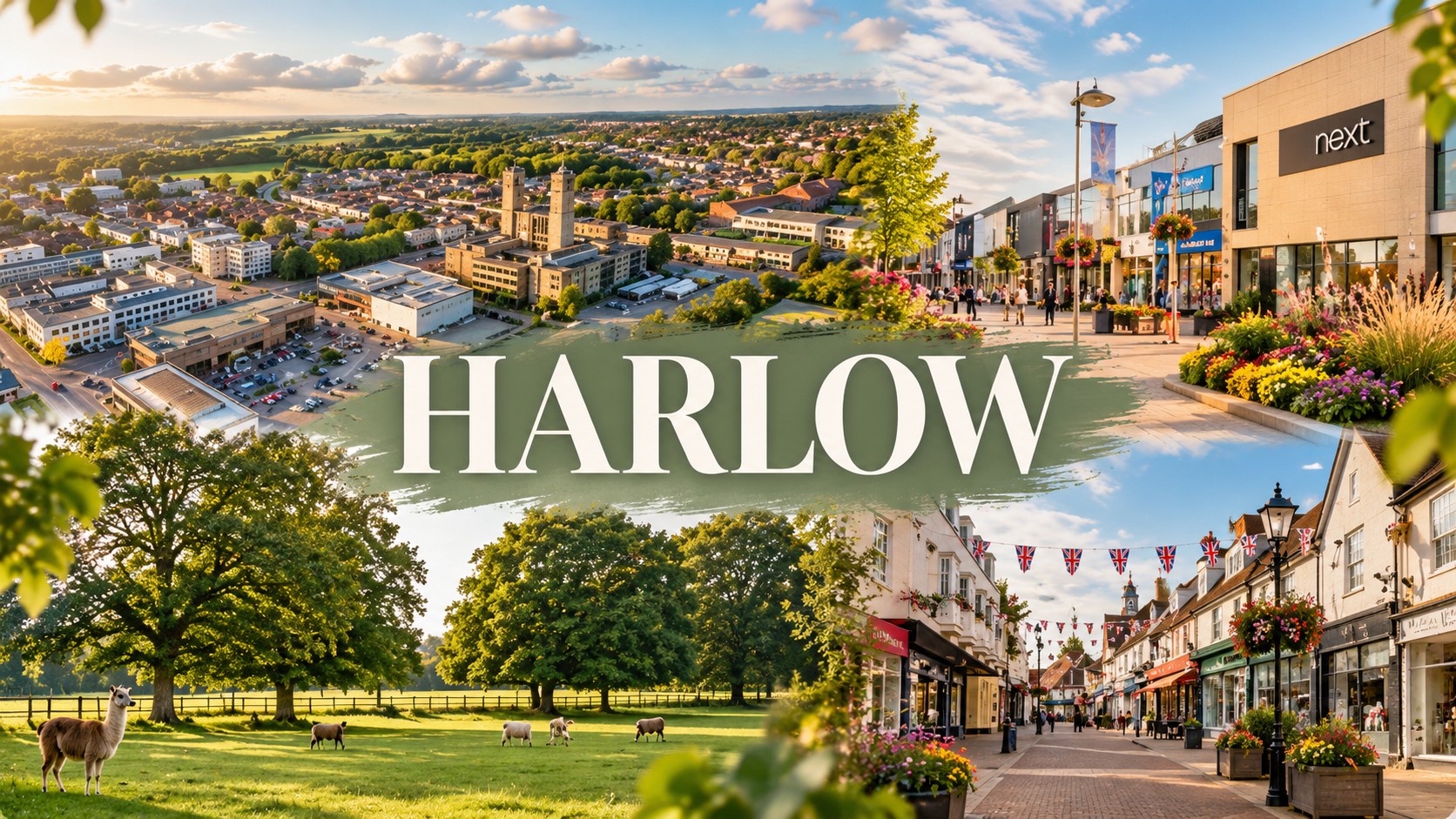
If you’re thinking about moving to Harlow, you’ll find an Essex town with a distinctive mix of post-war planning, established residential neighbourhoods, newer housing developments and extensive green spaces. Located close to the Hertfordshire border, Harlow offers rail connections towards London and Cambridge, making it a place to consider for people who want access to the capital without living in London itself.
Harlow is one of England’s original New Towns, designated in 1947 as part of a programme to provide new homes and communities outside London. Unlike traditional market towns that developed gradually over centuries, much of modern Harlow was deliberately planned around residential neighbourhoods, shopping areas, schools and open spaces.
The town is not entirely modern, however. Old Harlow retains a more traditional character, with historic buildings and older streets, while areas such as Church Langley and Newhall reflect later phases of residential development. These differences mean that choosing where to live in Harlow can make a noticeable difference to your everyday surroundings.
This guide covers the practical things to know before moving to Harlow in 2026, including house prices, rent, popular areas, transport and commuting, schools, safety, local life and the cost of living.
Is Harlow a Good Place to Live?
Whether Harlow is a good place to live depends on what you want from your next home. One of its defining features is its layout. The town was planned by architect and town planner Sir Frederick Gibberd, with residential neighbourhoods separated by landscaped open spaces known as Green Wedges. This gives many parts of Harlow access to greenery, walking routes and local facilities within their own neighbourhoods (Harlow Council, 2026d).
Harlow also has a more varied character than its New Town history might suggest. Old Harlow has older buildings and a traditional high street, while much of the central town reflects post-war development. Newer residential areas such as Church Langley and Newhall offer different housing styles and layouts, giving people several types of neighbourhood to consider (Harlow Council, 2026e).
Green space is a significant part of everyday life in Harlow. Harlow Town Park, the River Stort and the town’s network of walking and cycling routes provide opportunities to spend time outdoors. Harlow is also known for its public sculpture collection, with artworks integrated into streets, parks and residential areas rather than confined to galleries (Historic England, 2020; Harlow Council, 2026b).
For commuters, Harlow has two railway stations - Harlow Town and Harlow Mill - with services towards London and Cambridge. Harlow Town also has direct connections to Stansted Airport. However, the convenience of public transport varies across the town, so the location of a particular property matters when assessing daily journeys (Harlow Council, 2026e).
Harlow’s appeal lies partly in this combination of established neighbourhoods, green space, transport connections and different housing options. The town centre, older residential areas and newer developments can offer quite different living environments, making it useful to explore several parts of Harlow before deciding where to move.
Where Is Harlow?
Harlow is located in west Essex, close to the Hertfordshire border, approximately 25 miles north-east of central London. It sits within the Harlow local authority district, with neighbouring towns including Bishop’s Stortford to the north, Sawbridgeworth to the north-west and Epping to the south.
The town lies in the Stort Valley, with the River Stort running along its northern edge. The river forms part of the boundary between Essex and Hertfordshire and provides a network of waterside paths connecting Harlow with nearby countryside and neighbouring settlements.
Harlow has convenient road connections via the A414, which links the town with Hertford to the west and Chelmsford to the east. The nearby M11 motorway provides access towards London, Cambridge and Stansted Airport, while the M25 can be reached further south.
The town also has two railway stations, Harlow Town and Harlow Mill, on the West Anglia Main Line. Services connect Harlow with London Liverpool Street, Cambridge and Stansted Airport, making rail travel an important option for residents who work or study outside the town.
Although Harlow is within commuting distance of London, its planned neighbourhoods, extensive green spaces and proximity to the Essex and Hertfordshire countryside give it a different setting from London's outer suburbs.
Transport & Commuting in Harlow
Harlow has good transport connections for a town outside London, with two railway stations, access to the M11 motorway and local bus services linking its residential neighbourhoods. However, journey times can vary considerably depending on where you live, particularly as Harlow's planned layout means some areas are further from the railway stations than others.
Harlow Town is the town's main railway station, operated by Greater Anglia. Direct trains to London Liverpool Street typically take around 30–40 minutes, with services also stopping at Tottenham Hale, where passengers can change onto the Victoria line. Northbound services connect Harlow with Cambridge and Stansted Airport, making the station useful for both commuting and longer journeys (Greater Anglia, 2026).
Harlow Mill, situated towards the eastern side of the town near Old Harlow, provides another option for rail travel. It has services towards London Liverpool Street and Cambridge, although stopping patterns and journey times differ from those at Harlow Town. For residents of Old Harlow and nearby neighbourhoods, Harlow Mill may be more convenient than travelling across town to the main station (Greater Anglia, 2026).
For drivers, the A414 runs through Harlow, connecting the town with Hertford to the west and Chelmsford to the east. The nearby M11, accessible via Junction 7, provides connections towards London, Cambridge and Stansted Airport. Road journeys can be affected by congestion, particularly during peak commuting hours (National Highways, 2026).
Local buses connect Harlow's residential neighbourhoods with the town centre, railway stations and surrounding areas. Harlow also has an extensive network of cycle paths and pedestrian routes, reflecting its original New Town design. These provide alternatives to driving for some local journeys, although their convenience depends on the route and destination (Harlow Council, 2026d).
If commuting is an important part of your move, compare the journey from the actual property rather than relying only on the town's overall transport connections. Living near Harlow Town or Harlow Mill can make a significant difference to a daily rail commute, while other neighbourhoods may be better suited to residents who primarily travel by car or work locally.
House Prices in Harlow
House prices are an important consideration when moving to Harlow, particularly for buyers comparing different parts of Essex and the wider London commuter belt. Harlow offers a mixture of post-war houses, established residential streets, older properties around Old Harlow and newer developments in areas such as Newhall and Church Langley.
Unlike larger districts that contain several towns, Harlow is its own local authority area. This makes the official ONS house-price statistics a useful benchmark for the town, although individual property prices can still vary considerably between neighbourhoods.
According to provisional ONS data, the average house price in Harlow was £320,000 in July 2026, up from £306,000 in July 2025. This represents an annual increase of 4.4%. By comparison, the average house price across the East of England was £338,000 in July 2026 (ONS, 2026).
Prices vary considerably by property type. In July 2026, the average detached property in Harlow cost £630,000, compared with £438,000 for a semi-detached home, £322,000 for a terraced property and £184,000 for a flat or maisonette (ONS, 2026).
There is also a difference between buyer types. First-time buyers paid an average of £289,000, while home-movers paid around £381,000. These figures cover Harlow as a whole, so they should be used as a guide rather than an expected price for every property or neighbourhood (ONS, 2026).
Within Harlow, property prices can vary depending on the location, housing type and proximity to transport links. Older homes in Old Harlow, established New Town neighbourhoods and modern developments such as Newhall offer different types of housing, making it useful to compare properties beyond their asking prices.
💙 Movly tip: If you’re comparing two properties in Harlow, Movly’s Area Guide lets you compare their postcodes side by side, including Council Tax, crime, schools and broadband information. This can help you look beyond the asking price when deciding which location works better for your move.
Renting in Harlow
The average private rent in Harlow was £1,521 per month in August 2026, up from £1,462 a year earlier. This represents an annual increase of 4.0%, compared with 3.5% across the East of England. Harlow's average rent was also above the regional average of £1,289 (ONS, 2026).
Rental costs vary by property size. In August 2026, average monthly rents were £1,022 for a one-bedroom property, £1,327 for two bedrooms, £1,573 for three bedrooms and £2,199 for four or more bedrooms (ONS, 2026).
Property type also makes a difference. Flats and maisonettes averaged £1,127 per month, compared with £1,508 for terraced houses and £1,684 for semi-detached properties. These are Harlow-wide averages rather than asking rents for individual neighbourhoods (ONS, 2026).
For commuters, the distinction between Harlow Town and Harlow Mill stations is particularly relevant. Rental properties in Old Harlow, the town centre and newer developments such as Newhall can offer different housing styles and transport arrangements, so location matters alongside the monthly rent.
Popular Areas in Harlow
Harlow's neighbourhoods vary considerably, from the historic streets of Old Harlow to the planned residential estates of the New Town and more recent developments. Here are some of the main areas to consider.
Old Harlow retains much of the town's historic character, with older buildings, independent businesses and a traditional high street. Harlow Mill station is nearby, making this part of town particularly relevant for rail commuters.
Church Langley, in eastern Harlow, is a predominantly residential area developed from the 1990s onwards. It has its own local shopping facilities, primary schools and green spaces, although reaching the main railway stations generally requires a longer journey.
Newhall is a more recent development known for its contemporary architecture, varied housing designs and landscaped public spaces. Its layout differs noticeably from Harlow's original New Town neighbourhoods.
Mark Hall and Great Parndon reflect Harlow's post-war planning, with residential areas organised around local facilities and green spaces. Mark Hall is also home to the historic Mark Hall estate landscape, while Great Parndon covers established neighbourhoods in western Harlow (Harlow Council, 2026d).
The town centre and surrounding neighbourhoods offer access to shopping, leisure facilities and Harlow Town station, although the station is not directly within the main shopping centre. Property types and parking arrangements vary across these areas.
💙 Movly tip: Once you've found a property, Movly's Local Insights can show you nearby schools, parks, shops, GPs and other amenities. This is useful in Harlow, where neighbourhood layouts and access to everyday facilities can differ significantly.
Harlow Postcodes
Harlow is mainly covered by the CM17, CM18, CM19 and CM20 postcode districts. These extend across different parts of the town, but they do not follow neighbourhood boundaries exactly.
CM17 covers much of eastern Harlow, including Old Harlow, Church Langley and Newhall. CM18 includes southern neighbourhoods such as Staple Tye and parts of Great Parndon, while CM19 covers western areas including Sumners, Katherines and Kingsmoor. CM20 includes the town centre, Harlow Town station and nearby residential areas.
These distinctions matter when comparing properties. For example, a CM17 address in Old Harlow may offer convenient access to Harlow Mill station, while another CM17 property in Church Langley could be considerably further away. Postcodes alone also cannot confirm school admission priority or the nearest local services.
💙 Movly tip: Movly's Area Guide lets you compare two postcodes side by side, including Council Tax, crime, schools and broadband information. This can help you explore practical differences between locations before choosing a property.
Moving to Harlow with Children
For families considering a move to Harlow, one of the biggest advantages is the variety of activities available for children, from indoor adventures on rainy afternoons to free outdoor attractions. Whether you have a toddler who loves soft play or an older child looking for something more adventurous, there are plenty of ways to keep the whole family entertained.
One of the town's main family attractions is Harlow Leisurezone, on Second Avenue. It brings several activities together under one roof, including Kidzz Kingdom, a space-themed soft play area for children aged 0–10, complete with slides, ball pools, rope bridges and zip wires. Older children can try VertiGo Climb Challenge, which offers 22 climbing challenges for ages six and over, while Urban Limitz provides trampoline activities. There is also a 25-metre swimming pool, a separate learner pool, swimming lessons and family fun sessions, making Leisurezone particularly useful during weekends and school holidays (Harlow Leisurezone, 2026).
For a more relaxed and budget-friendly day out, Pets' Corner in Harlow Town Park is a lovely option. This small farm is free to enter and is home to animals including rabbits, chickens, ducks, llamas, alpacas and reindeer, as well as an aquarium featuring fish and reptiles. Families can visit throughout the week, with donations welcomed to help support the attraction (Harlow Council, 2026).
Harlow Town Park itself offers much more than open green space. Children can explore an adventure playground with a zip line and giant climbing net, while a separate inclusive play area near Pets' Corner features accessible equipment and sensory features. The park also has a paddling pool and skate park, giving families several reasons to return throughout the year. Across Harlow, the council maintains 43 playgrounds, so outdoor play is not limited to the town centre (Harlow Council, 2026).
For something different, families can visit Harlow Museum and Walled Gardens, which offers free admission, local history displays and family activities. Harlow Playhouse is another option, with a programme that includes pantomimes, performances and other events suitable for different ages (Harlow Council, 2026).
Together, these attractions give families a good mix of free outings, active indoor entertainment and activities for different age groups. For parents planning a move, having places like Pets' Corner, Leisurezone and the Town Park nearby can make everyday family life that little bit easier.
💙 Movly tip: Moving with children involves more than packing. Movly lets you share your moving checklist with your partner, divide responsibilities and set reminders.
Education in Harlow
Harlow has education options from early years through to further education, with some higher education pathways available locally. School admissions are coordinated by Essex County Council, although individual schools and academy trusts may have their own admissions criteria (Essex County Council, 2026a).
For younger children, Harlow has private nurseries, pre-schools, school-based nurseries and registered childminders. In England, all three- and four-year-olds are entitled to 15 hours of funded early education per week. Eligible working parents can receive up to 30 hours per week for children aged nine months to school age, normally over 38 weeks of the year. Some two-year-olds also qualify for funded childcare under additional eligibility criteria (GOV.UK, 2026a).
At primary level, schools include Church Langley Community Primary School, Newhall Primary Academy and Pear Tree Mead Academy. Families should check each school's admission arrangements and latest Ofsted reports rather than assuming that living nearby guarantees a place (Department for Education, 2026; Essex County Council, 2026a).
For secondary education, Harlow has several established schools, including Burnt Mill Academy, Passmores Academy, Stewards Academy, Mark Hall Academy and Sir Frederick Gibberd College. Admissions arrangements differ between schools, so families should check the latest criteria and Ofsted reports for their preferred schools (Essex County Council, 2026a; Department for Education, 2026).
For further education, Harlow College on Velizy Avenue offers vocational courses, apprenticeships and pathways into higher education. This gives students a local option for continuing their studies after secondary school (Harlow College, 2026).
💙 Movly tip: If schools are a priority, Movly's Area Guide lets you compare two postcodes side by side, including school information and the latest Ofsted details. Always confirm admission eligibility directly with the school or Essex County Council before making a decision.
Is Harlow a Safe Place to Live?
Safety is an important consideration when moving to Harlow, particularly because recorded crime can vary between its town centre, residential neighbourhoods and commercial areas. Town-wide crime figures should not be treated as a measure of safety for every street.
Harlow is policed by Essex Police. Police.uk allows residents to explore reported crime by location and category, and also publishes anti-social behaviour reports. Anti-social behaviour reports should not be treated as identical to recorded criminal offences (Police.uk, 2026).
OpenCrime reports 10,663 recorded offences in Harlow over the 12 months to July 2026, equivalent to approximately 108.6 per 1,000 residents. Its published comparison places that rate around 19% above the England and Wales figure and reports a 4.6% increase on the previous 12-month period. These are third-party calculations based on published police data; the rate and comparison depend on the source's methodology and population estimate (OpenCrime, 2026).
Recorded crime patterns differ across Harlow. Busy shopping and town-centre locations can show different categories of reports from residential streets. For an individual property, review the latest location-level information on Police.uk and consider the period covered, the categories shown and the limitations of recorded-crime data (Police.uk, 2026).
💙 Movly tip: Movly's Area Guide lets you compare crime information for two postcodes side by side, including crime types and comparisons with national figures. This gives a more relevant picture when choosing between individual properties in Harlow.
Local Life & Things to Do in Harlow
Harlow has a cultural identity shaped by its New Town history. It is particularly known as a sculpture town, with more than 100 public artworks displayed across its streets, parks and residential neighbourhoods. The collection includes works by artists such as Henry Moore, Barbara Hepworth and Auguste Rodin (Harlow Art Trust, 2026).
The Gibberd Garden, created by Harlow's master planner Sir Frederick Gibberd, is another distinctive attraction. Located near Old Harlow, it combines landscaped gardens, architectural features and outdoor sculptures. In the town centre, the Harlow Playhouse hosts theatre, comedy, music and community performances (The Gibberd Garden, 2026; Harlow Playhouse, 2026).
For everyday leisure, Harlow Town Park offers walking routes, gardens and Pets' Corner, while the nearby River Stort provides opportunities for waterside walks and cycling. The town also has shopping facilities at the Harvey Centre and the Water Gardens, alongside independent businesses in Old Harlow (Harlow Council, 2026c).
Harlow's appeal is not based on a traditional historic town centre like neighbouring Hertford. Instead, its public art, planned green spaces, cultural venues and contrasting neighbourhoods give it a character closely connected to its post-war development.
Healthcare in Harlow
Harlow is home to Princess Alexandra Hospital, a major NHS hospital on Hamstel Road. Unlike smaller community hospitals, it has a 24-hour A&E department, maternity services, surgical care and specialist outpatient clinics. The hospital serves Harlow and surrounding communities across west Essex and east Hertfordshire (The Princess Alexandra Hospital NHS Trust, 2026).
The hospital also provides diagnostic services, including imaging and blood tests, alongside children's healthcare and maternity care. Plans for a new Princess Alexandra Hospital form part of the government's New Hospital Programme. Under the published programme, construction is expected to begin between 2032 and 2034. The existing hospital continues to provide services while the project progresses (Department of Health and Social Care, 2025).
For everyday healthcare, Harlow has GP practices, dental surgeries, pharmacies and community health services across the town. Residents can use the NHS website to find GP practice registration information and check services available near their prospective address (NHS, 2026).
For families and people who rely on public transport, access to Princess Alexandra Hospital is particularly relevant. The hospital is located near Harlow Town station, with local bus connections also serving the area.
Green Spaces & Outdoors in Harlow
Green space is a defining feature of Harlow's New Town design. Sir Frederick Gibberd planned the town around Green Wedges - landscaped corridors separating residential neighbourhoods and connecting them with parks and the surrounding countryside. These remain an important part of Harlow's layout today (Harlow Council, 2026d).
Harlow Town Park covers more than 160 acres and includes landscaped gardens, woodland walks, playgrounds and Pets' Corner, a small animal attraction popular with families. The park is one of Harlow's best-known outdoor spaces and holds a Green Flag Award (Harlow Council, 2026c).
Along the town's northern edge, the River Stort offers towpath walks, cycling routes and views across the Stort Valley. Nearby Parndon Wood Nature Reserve provides ancient woodland, wildlife habitats and marked walking trails, offering a different environment from the town's more formal parks (Harlow Council, 2026e).
Other green spaces include Mark Hall Park and Jean McAlpine Park, alongside the smaller neighbourhood parks and open spaces built into Harlow's residential areas. Together, these provide outdoor options across the town rather than concentrating them in one central park.
Jobs & Working in Harlow
Harlow has employment opportunities across healthcare, manufacturing, logistics and specialist industries. Princess Alexandra Hospital is a significant local healthcare employer, while GSK has a clinical-trial supply packaging and distribution operation in Harlow. Harlow Innovation Park also provides commercial space for businesses. The types and availability of vacancies change, so jobseekers should check current employers and listings rather than assume that every sector is recruiting (GSK, 2026; The Princess Alexandra Hospital NHS Trust, 2026).
Other local employment is found in retail, education, public services and businesses serving Harlow and the surrounding area. Opportunities vary by employer and occupation, so it is worth researching actual vacancies and travel times before deciding where to live.
For residents who work elsewhere, the practical question is how reliably they can reach their workplace from a particular address. Comparing station access, rail timetables, local buses and road journeys can be more useful than relying on town-wide descriptions of commuting options (Greater Anglia, 2026).
For residents working outside the town, direct rail connections to London Liverpool Street, Tottenham Hale and Cambridge provide access to wider employment markets. This makes Harlow an option for people balancing local job opportunities with commuting (Greater Anglia, 2026).
Cost of Living in Harlow
Housing is likely to be the biggest expense for anyone moving to Harlow. Average house prices were around £320,000 in July 2026, while average private rents reached approximately £1,521 per month in August 2026. Actual costs vary considerably depending on property size, type and neighbourhood (ONS, 2026).
Council Tax is another important expense. Harlow Council collects Council Tax, but the amount payable depends on the property's valuation band and the annual charges set by the relevant authorities. Before committing to a property, check its Council Tax band and the current bill rather than relying on an estimate (Harlow Council, 2026a).
Households should also budget for gas and electricity, water, broadband, insurance and transport. Energy costs depend on consumption, tariff and payment method, while commuters should factor in rail fares, station parking or local bus journeys. Harlow's location outside London does not automatically mean lower overall living costs, particularly for households commuting regularly (Ofgem, 2026; Greater Anglia, 2026).
💙 Movly tip: Movly can help you compare broadband and utility options when preparing for your move, making it easier to organise essential services before moving day.
Population & Local Community in Harlow
Harlow had a population of approximately 93,300 residents at the 2021 Census, compared with around 81,900 in 2011. This represents growth of nearly 14% over the decade, reflecting the town's continued residential development and changing population (ONS, 2023).
Originally developed as a New Town to accommodate people moving out of London after the Second World War, Harlow has grown into a community with a mix of long-established residents, young families and people relocating for work or more affordable housing (Historic England, 2020).
The town's neighbourhood-based design continues to influence everyday life. Areas such as Old Harlow, Church Langley, Newhall and Great Parndon have different housing styles, local facilities and community spaces. Harlow also has sports clubs, community organisations, libraries and cultural activities, including events at Harlow Playhouse and Town Park (Harlow Council, 2026c).
For anyone moving to Harlow, exploring individual neighbourhoods is more useful than judging the town as a whole. Visiting local shops, parks and transport connections at different times can help you understand what everyday life might look like in your chosen area.
Your Moving to Harlow Checklist
Moving to Harlow involves more than packing boxes. From arranging removals to updating your address and setting up household services, a little preparation can make moving day much easier.
Here's a practical timeline to help you stay organised.
6-8 weeks before moving
Set your moving budget and compare removal quotes.
Research your chosen Harlow neighbourhood, including transport, schools and local amenities.
Check school admissions and childcare availability if you're moving with children.
Start sorting belongings and decide what to sell, donate or recycle.
3-4 weeks before moving
Confirm your removal company or van hire.
Arrange broadband and utility services for your new address.
Notify your landlord if required and check your tenancy obligations.
Begin updating your address with banks, insurers and other important organisations.
1 week before moving
Confirm moving-day arrangements and parking access, particularly if you're moving into a flat or a property with restricted parking.
Pack essentials separately and label your moving boxes.
Check your new property's Council Tax details with Harlow Council.
Find out your household waste and recycling collection arrangements.
Moving day and afterwards
Take electricity, gas and water meter readings where applicable.
Check the property, keys and any inventory documents.
Register with a local GP and update your driving licence and vehicle details where required.
Update your electoral registration and arrange mail redirection if needed.
💙 Movly tip: Movly's free moving checklist organises tasks into a personalised moving timeline. You can add your own tasks, share your checklist with your partner and set reminders, so important jobs don't get overlooked during your move.
Final Thoughts: Is Harlow the Right Place for You?
Harlow offers a combination of established residential neighbourhoods, green spaces and transport connections that makes it worth considering for a move in 2026. Its New Town design, public art and access to the River Stort give it a different character from many other towns in Essex.
There are practical advantages, particularly for people commuting to London or working in the surrounding area. However, choosing the right neighbourhood matters. Old Harlow, Church Langley, Newhall and the town centre offer different housing styles, amenities and everyday experiences.
Before making a decision, compare property costs, visit your preferred areas and check the transport, schools and services relevant to your household.
And when you're ready to start planning, Movly can help you compare locations, organise your moving checklist and manage the practical details of your move - all in one place.
Harlow might be the right fit, but the best decision comes from finding the neighbourhood and property that suit your lifestyle, priorities and budget.
FAQs About Moving to Harlow
Is Harlow a good place to live?
Harlow can be a good choice for people looking for a combination of green spaces, transport links and access to London. Its neighbourhoods vary considerably, so it's worth exploring areas such as Old Harlow, Church Langley and Newhall before deciding where to live.
Is Harlow expensive to live in?
Housing is one of the main costs to consider. Average house prices were approximately £320,000 in July 2026, while average monthly private rents were around £1,521 in August 2026. Your overall budget will also depend on Council Tax, energy bills and commuting costs (ONS, 2026).
How long does it take to commute from Harlow to London?
Direct trains from Harlow Town to London Liverpool Street typically take around 30–40 minutes, depending on the service. Harlow also has connections to Tottenham Hale, where passengers can change onto the London Underground (Greater Anglia, 2026).
What are the most popular areas to live in Harlow?
Old Harlow appeals to people looking for a more traditional setting, while Church Langley and Newhall offer more modern residential developments. Mark Hall and Great Parndon provide other established housing options. The right choice depends on your budget, preferred property type and daily travel needs.
Is Harlow safe?
Crime levels vary across Harlow, and town-wide statistics don't necessarily reflect individual neighbourhoods. Before choosing a property, check recent recorded crime data for the surrounding streets and visit the area at different times (Police.uk, 2026).
Are there good schools in Harlow?
Harlow has primary and secondary schools, including Church Langley Community Primary School, Burnt Mill Academy, Passmores Academy and Sir Frederick Gibberd College. Families should check current Ofsted reports, admissions criteria and school-place availability before moving (Essex County Council, 2026a; Ofsted, 2026).
Does Harlow have a hospital?
Yes. Princess Alexandra Hospital on Hamstel Road provides a 24-hour A&E department, maternity care, surgery and outpatient services. Harlow also has GP practices, pharmacies and other community healthcare services (The Princess Alexandra Hospital NHS Trust, 2026).
Can you live in Harlow without a car?
It's possible, particularly if you live near Harlow Town station, local shops and regular bus routes. However, some residential neighbourhoods are more spread out, so it's worth checking walking distances and public transport connections from the specific property you're considering.
What postcodes cover Harlow?
Harlow's main postcode districts are CM17, CM18, CM19 and CM20. They cover different parts of the town, although postcode boundaries don't always match neighbourhood boundaries. Comparing individual addresses is more useful than relying on a postcode district alone.
Is Harlow a good place for families?
Harlow has parks, playgrounds, schools and family attractions, including Pets' Corner in Harlow Town Park. Its network of Green Wedges also provides accessible outdoor spaces across many residential areas. School availability, childcare and proximity to everyday amenities are worth checking before choosing a neighbourhood (Harlow Council, 2026c).
How can Movly help with moving to Harlow?
Movly is a free UK moving app designed to make the moving process easier. You can compare two postcodes using Area Guide, explore nearby amenities with Local Insights, create a personalised moving checklist, set reminders and organise practical tasks before moving day.
Editorial data note: House prices and rents reflect the ONS release dated 16 September 2026 and may be revised. Crime totals quoted from OpenCrime are third-party calculations; readers should also consult Police.uk for local recorded incidents. Planned public projects and delivery dates may change.
References:
Department for Education (2026). Get Information about Schools. Available at: https://get-information-schools.service.gov.uk/. Accessed: 14 October 2026.
Department of Health and Social Care (2025). New Hospital Programme: plan for implementation. Available at: https://www.gov.uk/government/publications/new-hospital-programme-review-outcome/new-hospital-programme-plan-for-implementation. Accessed: 14 October 2026.
Department of Health and Social Care (2026). New Hospital Programme annual report: 2025 to 2026. Available at: https://www.gov.uk/government/publications/new-hospital-programme-annual-report-financial-year-2025-to-2026/new-hospital-programme-annual-report-2025-to-2026. Accessed: 14 October 2026.
Essex County Council (2026a). School admissions. Available at: https://www.essex.gov.uk/schools-and-learning/schools/admissions. Accessed: 14 October 2026.
Essex County Council (2026b). Early years and childcare. Available at: https://www.essex.gov.uk/children-young-people-and-families/early-years-and-childcare. Accessed: 14 October 2026.
GOV.UK (2026a). Check what help you could get with childcare costs. Available at: https://www.gov.uk/childcare-calculator. Accessed: 14 October 2026.
GOV.UK (2026b). Change the address on your driving licence. Available at: https://www.gov.uk/change-address-driving-licence. Accessed: 13 October 2026.
Greater Anglia (2026). Train times and tickets. Available at: https://www.greateranglia.co.uk/. Accessed: 13 October 2026.
GSK (2026). Research and development locations. Available at: https://www.gsk.com/en-gb/innovation/rd-locations/. Accessed: 13 October 2026.
Harlow Art Trust (2026). Harlow Sculpture Town. Available at: https://www.harlowsculpturetown.co.uk/. Accessed: 13 October 2026.
Harlow College (2026). Courses and apprenticeships. Available at: https://www.harlow-college.ac.uk/. Accessed: 14 October 2026.
Harlow Council (2026a). Council Tax. Available at: https://www.harlow.gov.uk/council-tax. Accessed: 13 October 2026.
Harlow Council (2026b). Harlow sculpture trail. Available at: https://www.harlow.gov.uk/parks-and-culture/harlow-sculpture-trail. Accessed: 13 October 2026.
Harlow Council (2026c). Harlow Town Park. Available at: https://www.harlow.gov.uk/parks-and-culture/parks-and-green-spaces/harlow-town-park. Accessed: 13 October 2026.
Harlow Council (2026d). Parks and culture. Available at: https://www.harlow.gov.uk/parks-and-culture. Accessed: 13 October 2026.
Harlow Council (2026e). Planning, regeneration and local services. Available at: https://www.harlow.gov.uk/. Accessed: 14 October 2026.
Harlow Playhouse (2026). What's on and venue information. Available at: https://www.harlowplayhouse.co.uk/. Accessed: 14 October 2026.
Historic England (2020). Harlow New Town and its historic environment. Available at: https://historicengland.org.uk/. Accessed: 13 October 2026.
National Highways (2026). Road network and travel information. Available at: https://nationalhighways.co.uk/. Accessed: 13 October 2026.
NHS (2026). Find NHS services near you. Available at: https://www.nhs.uk/nhs-services/services-near-you/. Accessed: 14 October 2026.
Office for National Statistics (2023). How life has changed in Harlow: Census 2021. Available at: https://www.ons.gov.uk/visualisations/censusareachanges/E07000073/. Accessed: 13 October 2026.
Office for National Statistics (2026). Housing prices in Harlow. Available at: https://www.ons.gov.uk/visualisations/housingpriceslocal/E07000073/. Accessed: 13 October 2026.
Ofgem (2026). Energy price cap. Available at: https://www.ofgem.gov.uk/energy-price-cap. Accessed: 14 October 2026.
Ofsted (2026). Find an inspection report. Available at: https://reports.ofsted.gov.uk/. Accessed: 14 October 2026.
OpenCrime (2026). Crime statistics for Harlow, Essex. Available at: https://opencrime.co.uk/essex/harlow/. Accessed: 13 October 2026.
Police.uk (2026). Crime and policing in your area. Available at: https://www.police.uk/. Accessed: 13 October 2026.
The Gibberd Garden (2026). Visitor information. Available at: https://www.thegibberdgarden.co.uk/. Accessed: 13 October 2026.
The Princess Alexandra Hospital NHS Trust (2026). Hospital services and patient information. Available at: https://www.pah.nhs.uk/. Accessed: 14 October 2026.
UK Parliament (2026). UK Health Security Agency: Harlow campus – Written Question. Available at: https://questions-statements.parliament.uk/written-questions/detail/2026-05-20/3208. Accessed: 14 October 2026.
Disclaimer
The information in this guide is provided for general informational purposes and was accurate to the best of our knowledge at the time of writing. Property prices, rental costs, Council Tax rates, transport services and local amenities may change over time. We recommend checking the latest information with official sources before making any decisions about your move.