Moving to Chelmsford in 2026? A Practical Guide to Living in Chelmsford
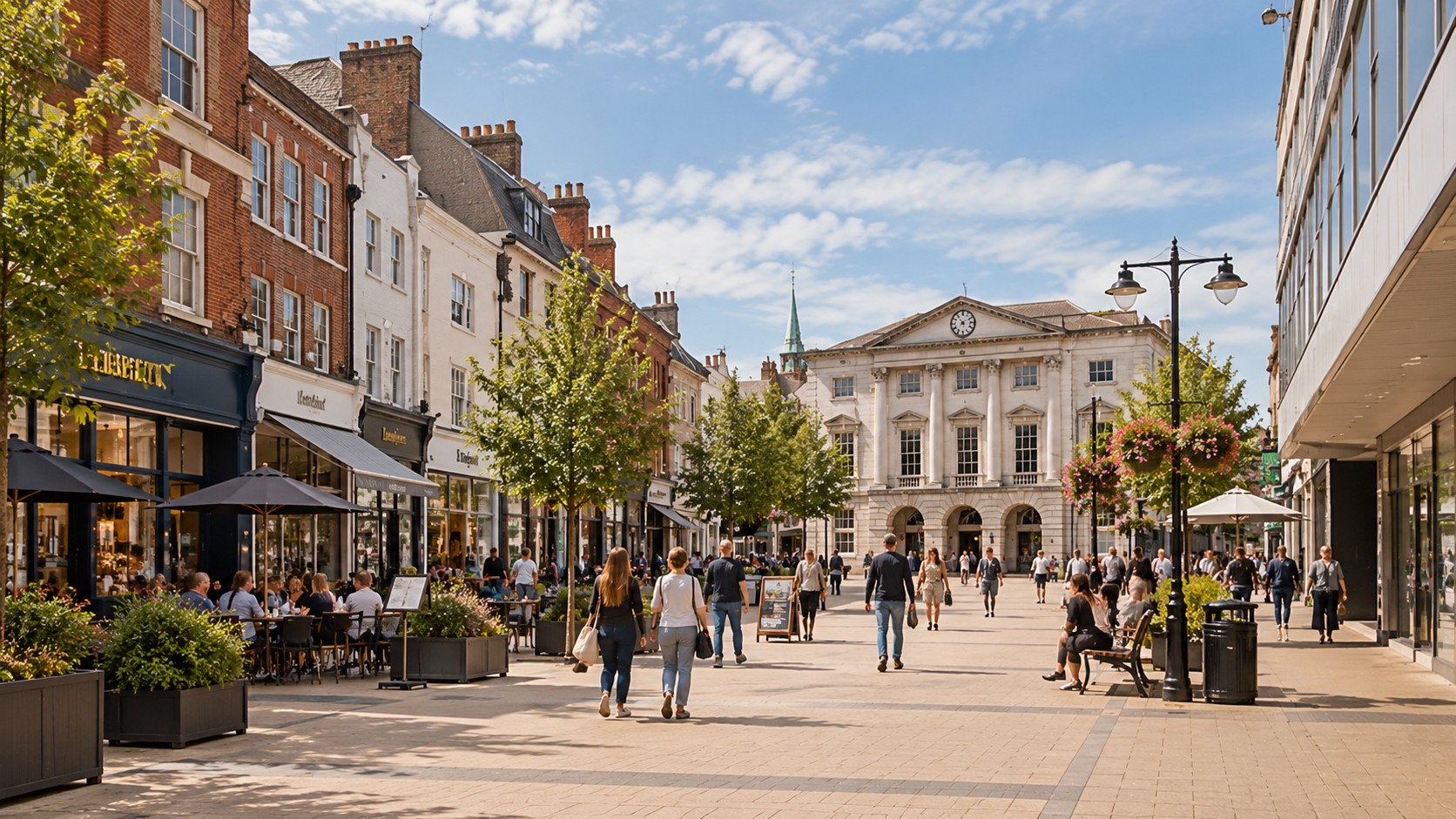
Thinking About Moving to Chelmsford?
If you’re thinking about moving to Chelmsford, you’ll find a city that combines a busy urban centre with residential neighbourhoods, surrounding villages and easy access to the Essex countryside. Chelmsford is the county city of Essex and sits in the East of England, with London within commuting distance.
The wider Chelmsford local authority area had a population of around 181,500 at the 2021 Census, up from around 168,300 in 2011. This represented growth of almost 8% over the decade, slightly below the increase across the East of England as a whole (ONS, 2023).
Where you choose to live can make a noticeable difference to your experience of Chelmsford. Areas closer to the city centre and railway station offer convenient access to shops, services and trains, while neighbourhoods and villages further out can have a very different setting and housing mix.
This guide covers the practical things to know before moving to Chelmsford in 2026, including house prices, rent, popular areas, transport and commuting, schools, safety, local life and the cost of living.
Is Chelmsford a Good Place to Live?
Whether Chelmsford is a good place to live will depend largely on your priorities. One of the city’s main practical advantages is its location: it offers direct rail connections to London while also providing access to the wider Essex countryside. This makes it an option for people who want to remain within commuting distance of the capital without living in London itself.
Chelmsford has a well-established city centre with shopping, restaurants, leisure facilities and cultural venues, while residential areas extend out towards smaller communities and villages. The city is also home to Anglia Ruskin University’s Chelmsford campus and Broomfield Hospital, both of which are significant local institutions.
The character of the area can change considerably depending on where you live. Central locations can be more convenient for the railway station and city-centre amenities, while areas further out may offer more residential surroundings but different transport considerations.
For anyone considering a move, it is therefore worth looking beyond Chelmsford as a whole and comparing individual neighbourhoods based on housing costs, commuting, schools, local amenities and the type of property you are looking for.
Where Is Chelmsford?
Chelmsford is in Essex, in the East of England. The city sits north-east of London and is surrounded by a mixture of towns, villages and countryside. The wider Chelmsford local authority area includes communities such as Broomfield, Writtle, Boreham, Great Baddow, Danbury and South Woodham Ferrers (Chelmsford City Council, 2026).
Its location gives Chelmsford useful connections across Essex and towards London. The A12 is one of the main road links through the area, while the A130, A131 and A414 provide connections to other parts of Essex. Chelmsford also sits on the Great Eastern Main Line, which links the city with London Liverpool Street and destinations further into the East of England (Chelmsford City Council, 2026).
The wider council area extends well beyond Chelmsford’s urban centre, so the setting can change considerably depending on where you live. Some locations are closely connected to the city itself, while others have a more rural or village character. This is worth keeping in mind when comparing properties across the wider Chelmsford area (Chelmsford City Council, 2026).
Transport & Commuting
Chelmsford’s transport links are one of the practical factors to consider if you need to commute. Chelmsford railway station is on the Great Eastern Main Line, with direct Greater Anglia services to London Liverpool Street. On weekdays, there are up to five trains per hour, with some direct journeys taking around 29-32 minutes (Greater Anglia, 2026).
Trains also connect Chelmsford with destinations further into Essex and East Anglia, including Colchester, Ipswich and Norwich. For people travelling towards London, many services also stop at Stratford, providing connections to other parts of the capital (Greater Anglia, 2026).
By road, the A12 is the main route linking Chelmsford with London and Colchester, while the A130, A131 and A414 provide connections to other parts of Essex. Bus services operate across the city and surrounding communities, although the convenience of public transport can vary depending on how far you live from the city centre and railway station (Chelmsford City Council, 2026).
If commuting is an important part of your move, it is worth checking the journey from the specific property, rather than looking only at the distance to Chelmsford station. Walking or bus time to the station, parking and the frequency of local services can make a noticeable difference to the overall commute.
House Prices in Chelmsford
The average house price in Chelmsford was £378,000 in July 2026, based on provisional ONS data. This was down from £387,000 in July 2025, representing a 2.3% fall over the year (ONS, 2026).
Prices vary considerably depending on the type of property. In July 2026, the average detached home cost £682,000, compared with £424,000 for a semi-detached property, £339,000 for a terraced home and £208,000 for a flat or maisonette (ONS, 2026).
There is also a noticeable difference depending on the type of buyer. First-time buyers paid an average of £298,000, while home-movers paid £473,000. Homes bought with a mortgage averaged £375,000, compared with £392,000 for cash buyers (ONS, 2026).
These figures cover the Chelmsford local authority area, so they should be treated as a useful overall benchmark rather than the expected price for every neighbourhood. Property type, location and proximity to transport and local amenities can all make a difference when comparing individual homes.
💙 Movly tip: If you’re choosing between two locations in Chelmsford, Movly’s Area Guide lets you compare two postcodes side by side, including Council Tax, crime, schools and broadband information. This can help you look beyond the property price when deciding which location works better for your move.
Renting in Chelmsford
The average private rent in Chelmsford was £1,439 per month in August 2026, up from £1,406 a year earlier. This represents an annual increase of 2.4% (ONS, 2026).
Rental costs vary depending on the size of the property. In August 2026, the average monthly rent was £1,059 for a one-bedroom property, £1,291 for two bedrooms, £1,543 for three bedrooms and £2,220 for properties with four or more bedrooms (ONS, 2026).
There are also differences by property type. The average rent was £1,210 for a flat or maisonette, compared with £1,370 for a terraced property, £1,521 for a semi-detached home and £1,993 for a detached property (ONS, 2026).
These figures cover the wider Chelmsford local authority area, so the rent for an individual property can differ depending on its location, size and type. If access to the railway station is important for your move, it is worth comparing the overall journey from the property as well as the monthly rent.
Popular Areas in Chelmsford
Chelmsford includes a mixture of central neighbourhoods, established residential areas and surrounding villages. The right location will depend on whether you prioritise access to the railway station and city centre, local amenities, newer housing or a more village-style setting.
Moulsham and Central Chelmsford put you close to the city centre and within relatively easy reach of Chelmsford railway station. This part of the city includes established residential streets alongside shops, restaurants and other central amenities.
Great Baddow is a large established community to the south-east of central Chelmsford, while Springfield lies to the north-east. Both form part of the wider Chelmsford urban area but have their own residential centres and local services (ONS, 2026).
Chelmer Village and Beaulieu Park are on the eastern and north-eastern side of Chelmsford. These areas include more recent residential development alongside established neighbourhoods, making the housing mix noticeably different from some of the older parts of the city (ONS, 2026).
Writtle, west of central Chelmsford, has a distinct village identity and its own adopted Neighbourhood Plan. Broomfield, to the north, also has an adopted Neighbourhood Plan, reflecting its separate local character within the wider Chelmsford area (Chelmsford City Council, 2026).
Further out, places such as Danbury, Boreham and South Woodham Ferrers offer different settings again. They are all within the Chelmsford local authority area, but they should not be treated as extensions of Chelmsford city centre when comparing properties, particularly if commuting or regular access to the railway station is important (Chelmsford City Council, 2026).
💙 Movly tip: Once you have found a property you are considering, Movly’s Local Insights can show you what is around that specific location, including nearby schools, parks, shops, GPs and other local amenities. This makes it easier to understand what everyday life around the property could actually look like.
Chelmsford Postcodes
Chelmsford uses the CM postcode area, with CM1 and CM2 covering much of the city itself. CM1 includes addresses in areas such as central Chelmsford, Springfield, Broomfield and Writtle, while CM2 includes parts of Moulsham, Great Baddow, Chelmer Village and Galleywood (Chelmsford City Council, 2026).
CM3 covers a much wider area to the east and south of the city, including places such as Danbury and South Woodham Ferrers. The wider Chelmsford local authority area also extends across additional postcode districts, so a CM postcode does not necessarily mean that a property is within Chelmsford City Council’s boundary (Chelmsford City Council, 2026).
Postcode districts should therefore be treated as a useful location reference rather than exact neighbourhood boundaries. If you are comparing properties, it is worth checking the full address, particularly for Council Tax, schools and other services that can depend on the property's precise location.
💙 Movly tip: With Movly’s Area Guide, you can compare two postcodes side by side and look at information including Council Tax, crime, schools and broadband. This can be particularly useful when two properties have a Chelmsford postal address but are in different parts of the wider area.
Moving to Chelmsford with Children
If you’re moving to Chelmsford with children, the exact location of your new home can be particularly important. Essex County Council uses priority admission areas for many schools, and its online finder allows parents to check which priority admission area applies to a specific address. Being within a priority admission area does not automatically guarantee a school place, so it is worth checking the admissions criteria before choosing a property (Essex County Council, 2026).
If your child is already at school and you are moving during the academic year, Essex County Council also provides information about changing schools. When an address changes during the admissions process, the council may require evidence such as a signed tenancy agreement or confirmation that contracts have been exchanged on a property (Essex County Council, 2026).
Families can also access the Essex Child and Family Wellbeing Service, which supports parents, carers and children from birth to 19, or up to 25 for young people with SEND. Services include Family Hub activities and support with areas such as child development, emotional wellbeing and transitions to school (Essex County Council, 2026).
Chelmsford City Council also runs family activities across the district. In summer 2026, for example, its programme included free Play in the Park sessions at different locations, alongside activities at venues such as the Museum of Chelmsford and Melbourne Park (Chelmsford City Council, 2026).
💙 Movly tip: If you’re moving as a family, you can share your Movly checklist with your partner, divide moving tasks between you and set reminders for important jobs. This can be particularly useful when you are managing school arrangements, packing and the practical parts of the move at the same time.
Education in Chelmsford
Chelmsford has education options covering the full journey from nursery and early years provision through to primary and secondary schools and university-level study. For families moving with children, the exact address can be important because admissions arrangements and priority admission areas vary between schools (Essex County Council, 2026).
For younger children, there is a mixture of private nurseries and pre-schools, school-based nursery provision and registered childminders across Essex. Funded early education can be used with approved providers, including nurseries, pre-schools, schools, academies and registered childminders. In 2026, all three- and four-year-olds can receive 15 funded hours a week, while eligible working parents can receive up to 30 funded hours a week for children from nine months old until they start Reception. Additional funded provision is available for some two-year-olds depending on family circumstances (Essex County Council, 2026).
Chelmsford has a wide range of primary schools across the city and surrounding communities. Larger examples include Mildmay Primary School, which has more than 600 pupils, and Barnes Farm Primary School, with more than 500 pupils. Other schools serving different parts of Chelmsford include Springfield Primary School, Trinity Road Primary School and schools in surrounding communities such as Writtle and Boreham. Admissions criteria differ between schools, and living within a priority admission area does not automatically guarantee a place (Essex County Council, 2026).
At secondary level, schools serving the Chelmsford area include The Boswells School, Moulsham High School, Great Baddow High School, Chelmer Valley High School, The Sandon School, Hylands School and Beaulieu Park School. Chelmsford is also home to two selective grammar schools: King Edward VI Grammar School and Chelmsford County High School for Girls. Grammar schools have their own selective admissions arrangements, while some other secondary schools also require supplementary information as part of the application process (Essex County Council, 2026).
School admissions are therefore worth checking against the specific property you are considering. Priority admission areas, individual school criteria and available places can all affect an application, so families should check the latest arrangements and Ofsted information rather than choosing a property based only on the nearest school.
Chelmsford also has its own university campus. Anglia Ruskin University (ARU) has a large riverside campus in the city, with more than 6,000 students and facilities including Essex’s first School of Medicine, a Business School, engineering laboratories and healthcare training facilities. Courses available in Chelmsford cover areas including medicine and healthcare, engineering and the built environment, business, finance, computing, education and law (Anglia Ruskin University, 2026).
ARU also has a campus in nearby Writtle, following the merger of Writtle University College with Anglia Ruskin University. The campus specialises in subjects including agriculture, horticulture, animal care and management, conservation and sport, with specialist facilities including a working farm and equine and canine centres (Anglia Ruskin University, 2026).
💙 Movly tip: If schools are an important part of your move, Movly’s Area Guide lets you compare two postcodes side by side and view school and latest Ofsted information alongside other local details.
Is Chelmsford a Safe Place to Live?
Crime levels in Chelmsford vary depending on the part of the city and the type of offence, so it is more useful to look at the specific neighbourhood or postcode you are considering rather than apply a single “safe” or “unsafe” label to the whole area. The latest ONS crime dataset available in 2026 covers the year ending March 2026 and provides police-recorded crime data at Community Safety Partnership level (ONS, 2026).
More recent neighbourhood-level data from Essex Police shows how crime patterns can vary within Chelmsford. In Chelmsford Town, 717 crimes were recorded in August 2026, with violence and sexual offences, shoplifting and anti-social behaviour among the most commonly reported categories (Essex Police, 2026).
These figures should be interpreted carefully because the police neighbourhoods cover different populations and geographical areas, so raw totals are not a direct measure of how likely an individual is to experience crime. They do, however, show why checking local data around a particular property is more useful than relying on a city-wide impression.
💙 Movly tip: Movly’s Area Guide, lets you compare crime information for two postcodes side by side, alongside Council Tax, schools and broadband. You can also see a breakdown by crime type and how the local crime rate compares with the national level, giving you more context when comparing potential locations.
Local Life & Things to Do in Chelmsford
Chelmsford has a compact city centre with shops, restaurants, cafés, entertainment and cultural venues, while some of its larger attractions and open spaces sit further out. The city also runs a regular programme of festivals, markets and community events throughout the year (Chelmsford City Council, 2026).
Hylands Estate is one of Chelmsford’s main cultural and event locations. The estate hosts a changing programme that includes music events, outdoor cinema and theatre, seasonal trails and other large-scale events. Its 2026 calendar included the National Flower Show, State Fayre, outdoor theatre and the Enlightened winter light trail (Chelmsford City Council, 2026).
Closer to the centre, the Museum of Chelmsford in Oaklands Park explores the history of the city and surrounding area, while Chelmsford Theatre hosts theatre, comedy, music and touring productions. Chelmsford Market and the city’s programme of public events provide additional options throughout the year (Chelmsford City Council, 2026).
For sport and leisure, Riverside Leisure Centre is located close to the city centre beside the River Chelmer. Facilities include a 25-metre swimming pool, learner pool, ice rink, gym, sports hall and exercise studios (Chelmsford City Council, 2026).
The mix of city-centre facilities and larger venues such as Hylands means you do not necessarily need to travel outside Chelmsford for everyday leisure and entertainment. At the same time, what is easiest to access will depend on where you live within the wider district, particularly if you are moving to one of the surrounding villages.
Healthcare in Chelmsford
Chelmsford is served by a network of GP surgeries, community healthcare services and hospital care. If you are moving to the area, you can use the NHS postcode search to find GP practices close to your new address and check their registration information (NHS, 2026).
The main hospital serving Chelmsford is Broomfield Hospital, located on Court Road in Broomfield. It is managed by Mid and South Essex NHS Foundation Trust and provides a wide range of hospital services, including emergency care, surgery, maternity and paediatric services (Mid and South Essex NHS Foundation Trust, 2026).
Broomfield Hospital also has a 24-hour Accident & Emergency department for both adults and children. The hospital can be reached by several bus services, and a weekday shuttle operates between Chelmer Valley Park and Ride and the hospital (NHS, 2026; Mid and South Essex NHS Foundation Trust, 2026).
Community healthcare in Chelmsford, Braintree and Maldon is provided by Provide Health, while mental health services are available through Essex Partnership University NHS Foundation Trust. Since April 2026, most NHS services across Essex, including GP, community, children’s and mental health services, have been planned and funded through the NHS Essex Integrated Care Board (Essex County Council, 2026).
If access to healthcare is particularly important for your household, it is worth checking the nearest GP surgery, pharmacy and route to Broomfield Hospital from the specific property you are considering.
Green Spaces & Outdoors
Chelmsford has a substantial network of parks, nature reserves and other open spaces across the city and wider district. In 2026, 19 parks and green spaces in Chelmsford held Green Flag Awards, the highest number the council had achieved and, at the time, the highest number in the East of England (Chelmsford City Council, 2026).
Close to the city centre, Central Park provides open green space within walking distance of the main shopping areas and railway station. The park connects with riverside routes through the city, while nearby Admirals Park and Tower Gardens extend the green corridor further west.
Hylands Estate offers a very different setting on the western edge of Chelmsford. Its extensive parkland makes it one of the larger outdoor spaces in the area and it is also used for events throughout the year. Elsewhere, Chelmer Valley Local Nature Reserve provides open space along the River Chelmer, with walking routes through the river valley (Chelmsford City Council, 2026).
Other green spaces include Oaklands Park, Springfield Hall Park, Chelmer Park and Melbourne Park, alongside smaller recreation grounds and local nature reserves. Chelmsford City Council currently manages around 692 hectares of grassland, covering parks, nature reserves, sports grounds and roadside verges (Chelmsford City Council, 2026).
The amount and type of green space nearby will vary considerably across the wider Chelmsford area, so if outdoor space matters to your move, it is worth looking at what is actually within walking distance of the property rather than judging the area only by its distance from the countryside.
Jobs & Working in Chelmsford
Chelmsford is an important employment centre within Essex, with jobs spread across healthcare, retail, public services, professional services, education and other sectors. In 2024, there were around 108,000 jobs across the Chelmsford local authority area, giving the area a jobs density of 0.92 jobs for every resident aged 16-64 (Nomis, 2026).
Healthcare and social work was the largest employee sector in 2024, accounting for around 17,000 jobs. Wholesale and retail accounted for approximately 14,000, professional, scientific and technical activities for 10,000, public administration and defence for 9,000, and education for 8,000 (Nomis, 2026).
The latest labour market figures show that around 87,700 Chelmsford residents were in employment between April 2025 and March 2026, equivalent to 74.2% of residents aged 16-64. Managers, directors, professional and associate professional occupations together represented more than half of employed residents (Nomis, 2026).
Chelmsford also has a sizeable local business base. In 2026, there were around 8,305 registered enterprises, almost 90% of which were micro-businesses employing fewer than ten people (Nomis, 2026).
The city’s rail connection with London also means that living in Chelmsford does not necessarily mean working locally. Chelmsford City Council estimates that more than half of the working population both lives and works within Chelmsford, while around 20% commute to London for work (Chelmsford City Council, 2026).
Cost of Living in Chelmsford
The cost of living in Chelmsford will depend heavily on your housing and household circumstances. Housing is likely to be one of the largest expenses: the average private rent was £1,439 per month in August 2026, while the average house price was £378,000 in July 2026 (ONS, 2026).
Council Tax is another cost to factor into your budget. Charges depend on the property's valuation band and its location within the Chelmsford district, as parish or town council charges can affect the final bill. For 2026/27, Chelmsford City Council publishes separate Council Tax charges for each band and area, so it is worth checking the exact property rather than relying on a single district-wide figure (Chelmsford City Council, 2026).
From 1 October to 31 December 2026, Ofgem’s energy price cap for a typical household on a default tariff paying by Direct Debit is £1,723 per year. This is not a maximum household bill, as the amount you actually pay still depends on how much energy you use (Ofgem, 2026).
Other everyday costs will naturally vary depending on your household and lifestyle. Commuters should also factor in rail or parking costs, while families may need to consider childcare and school-related expenses alongside housing and household bills.
💙 Movly tip: Moving home is a good time to review your household bills. With Movly, you can compare utilities and broadband options for your new home in one place, and switch when you find an option that suits your needs and budget.
Population & Local Community
Chelmsford had a population of around 181,500 at the 2021 Census, compared with approximately 168,300 in 2011. This represents growth of 7.9% over the decade, slightly below the 8.3% increase across the East of England but above the 6.6% increase across England (ONS, 2023).
The population also has a fairly broad age profile. The median age in Chelmsford was 41 in 2021, compared with 40 across England. Residents aged 35–49 represented 20.3% of the population, while 19.4% were aged 50–64 and 10.2% were aged 65–74 (ONS, 2023).
Chelmsford has also become more ethnically diverse. In 2021, 88.5% of residents identified within the White ethnic group, 5.3% as Asian, Asian British or Asian Welsh, 2.6% as Black, Black British, Black Welsh, Caribbean or African, and 2.6% within Mixed or Multiple ethnic groups. In 2011, 93.9% of residents had identified within the White ethnic group (ONS, 2023).
Around 86.2% of residents were born in England. India was the next most commonly reported individual country of birth, accounting for around 1.7% of Chelmsford’s population (ONS, 2023).
These figures cover the whole Chelmsford local authority area, including communities beyond the city centre, so individual neighbourhoods and villages can have noticeably different population profiles.
Your Moving to Chelmsford Checklist
Moving to Chelmsford involves plenty of small jobs, so starting early can make it easier to keep everything organised. Here are some of the key tasks from the Movly moving house checklist.
8 weeks before: create your moving budget, start decluttering, organise important documents, get packing supplies and book your removal company or van. If needed, check parking arrangements at both properties and organise storage.
2–3 weeks before: notify Council Tax, arrange your Royal Mail redirection, update your driving licence and start setting up broadband for your new address. This is also a good time to inform your GP and dentist, arrange childcare or pet care for moving day and schedule any final cleaning.
1 week before: update your bank, insurance and TV Licence, confirm arrangements with your movers, finish packing and prepare a separate essentials box or bag with toiletries, medication, chargers, important documents and a change of clothes.
Moving day: take and photograph your gas, electricity and water meter readings, complete a final walkthrough, hand over and collect your keys and make sure nothing has been left behind. If you are renting, photograph the condition of the property you are leaving and keep the images for your records.
After the move: unpack your essentials first, register with a local GP and dentist, test smoke and carbon monoxide alarms, locate the fuse box, water shut-off and boiler controls, check your broadband connection and find out your local bin and recycling collection days.
💙 Movly tip: This is only a snapshot of the full checklist. Movly gives you a personalised 8-week moving timeline with tasks for each stage of your move, including additional steps for buyers and renters. You can add your own tasks, set reminders and share your checklist with your partner.
Final Thoughts
Chelmsford combines the facilities of a city with access to surrounding villages and the wider Essex countryside. Its direct rail connection to London Liverpool Street is an important consideration for commuters, while the city itself provides local employment, education, healthcare, shopping and leisure options.
Where you choose to live can make a noticeable difference. Housing costs, access to Chelmsford railway station, school admissions, local amenities and the overall character of the area can vary between central neighbourhoods, established residential areas and communities further from the city centre.
If you’re considering moving to Chelmsford in 2026, compare the locations that fit your priorities and look closely at the practical details around the individual property before making your decision.
Frequently Asked Questions About Moving to Chelmsford
Is Chelmsford a good place to live?
Chelmsford can suit people looking for a city with direct rail connections to London, local employment, shopping and leisure facilities, as well as access to surrounding villages and countryside. Whether it is right for you will depend on factors such as your budget, commute, preferred type of property and the location of schools or other amenities.
How much does a house cost in Chelmsford?
The average house price in Chelmsford was £378,000 in July 2026, according to provisional ONS data. Detached properties averaged £682,000, semi-detached homes £424,000, terraced properties £339,000 and flats or maisonettes £208,000 (ONS, 2026).
How much is rent in Chelmsford?
The average private rent in Chelmsford was £1,439 per month in August 2026. Average rents ranged from £1,059 for a one-bedroom property to £2,220 for a property with four or more bedrooms (ONS, 2026).
What are some popular areas to live in Chelmsford?
Areas people may consider include Moulsham, Great Baddow, Springfield, Chelmer Village, Beaulieu Park, Broomfield and Writtle. The wider Chelmsford area also includes communities such as Danbury, Boreham and South Woodham Ferrers. These locations differ in housing, transport connections, local amenities and their proximity to the city centre.
What postcodes cover Chelmsford?
Much of Chelmsford itself falls within the CM1 and CM2 postcode districts, while CM3 covers a wider area to the east and south, including places such as Danbury and South Woodham Ferrers. Postcode boundaries do not correspond exactly with neighbourhood or local authority boundaries, so it is worth checking the full address of a property.
How long is the train from Chelmsford to London?
Chelmsford has direct Greater Anglia services to London Liverpool Street, with up to five trains per hour on weekdays. Some services complete the journey in around 32 minutes, although journey times vary depending on the service (Greater Anglia, 2026).
Is Chelmsford a commuter city?
Chelmsford’s direct rail connection to London makes commuting possible, while the city also has a substantial employment market of its own. Chelmsford City Council estimates that more than half of the working population both lives and works within Chelmsford, while around 20% commute to London for work (Chelmsford City Council, 2026).
Is Chelmsford a safe place to live?
Crime varies across Chelmsford, so a city-wide label does not give the full picture. For example, Essex Police recorded 717 crimes in the Chelmsford Town policing area in August 2026, but crime levels and types differ across other parts of the district. Checking data for the specific neighbourhood or postcode you are considering provides more useful context (Essex Police, 2026).
Are there good schools in Chelmsford?
Chelmsford has primary and secondary schools as well as two selective grammar schools, King Edward VI Grammar School and Chelmsford County High School for Girls. Admissions arrangements vary, and living within a priority admission area does not automatically guarantee a place, so families should check the criteria and latest Ofsted information for schools relevant to their specific address (Essex County Council, 2026).
Does Chelmsford have a university?
Yes. Anglia Ruskin University has a campus in Chelmsford, and ARU also has a campus in nearby Writtle. The Writtle campus specialises in subjects including agriculture, horticulture, animal care and management, conservation and sport (Anglia Ruskin University, 2026).
What is Chelmsford known for?
Chelmsford is the county city of Essex and is known for its connections to London, its city centre, Hylands Estate and its history of engineering and industry. Today, it combines an urban centre with established residential neighbourhoods, parks and surrounding villages.
References:
Anglia Ruskin University (2026). Chelmsford campus.
Anglia Ruskin University – Chelmsford campus
Anglia Ruskin University (2026). Writtle campus.
Anglia Ruskin University – Writtle campus
Chelmsford City Council (2026). Bands and amounts – Council Tax 2026 to 2027.
Chelmsford City Council – Council Tax bands and amounts
Chelmsford City Council (2026). Chelmsford Local Plan and planning evidence.
Chelmsford City Council – Local Plan
Chelmsford City Council (2026). Neighbourhood development plans.
Chelmsford City Council – Neighbourhood development plans
Chelmsford City Council (2026). Parks and green spaces.
Chelmsford City Council – Parks and allotments
Chelmsford City Council (2026). Riverside Leisure Centre.
Chelmsford City Council – Riverside Leisure Centre
Chelmsford City Council (2026). Economic development and employment evidence.
Chelmsford City Council – Economic development
City Life Chelmsford (2026). What’s on in Chelmsford.
City Life Chelmsford – What’s on
Essex County Council (2026). School admissions.
Essex County Council – School admissions
Essex County Council (2026). Priority admission (catchment) area finder.
Essex County Council – Priority admission area finder
Essex County Council (2026). Early years and childcare.
Essex County Council – Early years and childcare
Essex Police (2026). Chelmsford Town – local crime data.
Essex Police – Chelmsford Town crime data
Greater Anglia (2026). Trains from Chelmsford to London Liverpool Street.
Greater Anglia – Chelmsford to London Liverpool Street
Mid and South Essex NHS Foundation Trust (2026). Broomfield Hospital.
Mid and South Essex NHS Foundation Trust – Broomfield Hospital
Movly (2026). Moving House Checklist.
Movly – Moving House Checklist
NHS (2026). Find a GP.
NHS – Find a GP
Nomis (2026). Labour Market Profile – Chelmsford. Office for National Statistics.
Nomis – Chelmsford Labour Market Profile
Office for National Statistics (2023). How life has changed in Chelmsford: Census 2021.
ONS – Census 2021: Chelmsford
Office for National Statistics (2026). Housing prices in Chelmsford.
ONS – Housing prices and private rents in Chelmsford
Ofgem (2026). Energy price cap.
Ofgem – Energy price cap
Disclaimer
The information in this guide is provided for general informational purposes and was accurate to the best of our knowledge at the time of writing. Property prices, rental costs, Council Tax rates, transport services and local amenities may change over time. We recommend checking the latest information with official sources before making any decisions about your move.