How to set up your utilities when you move (UK)
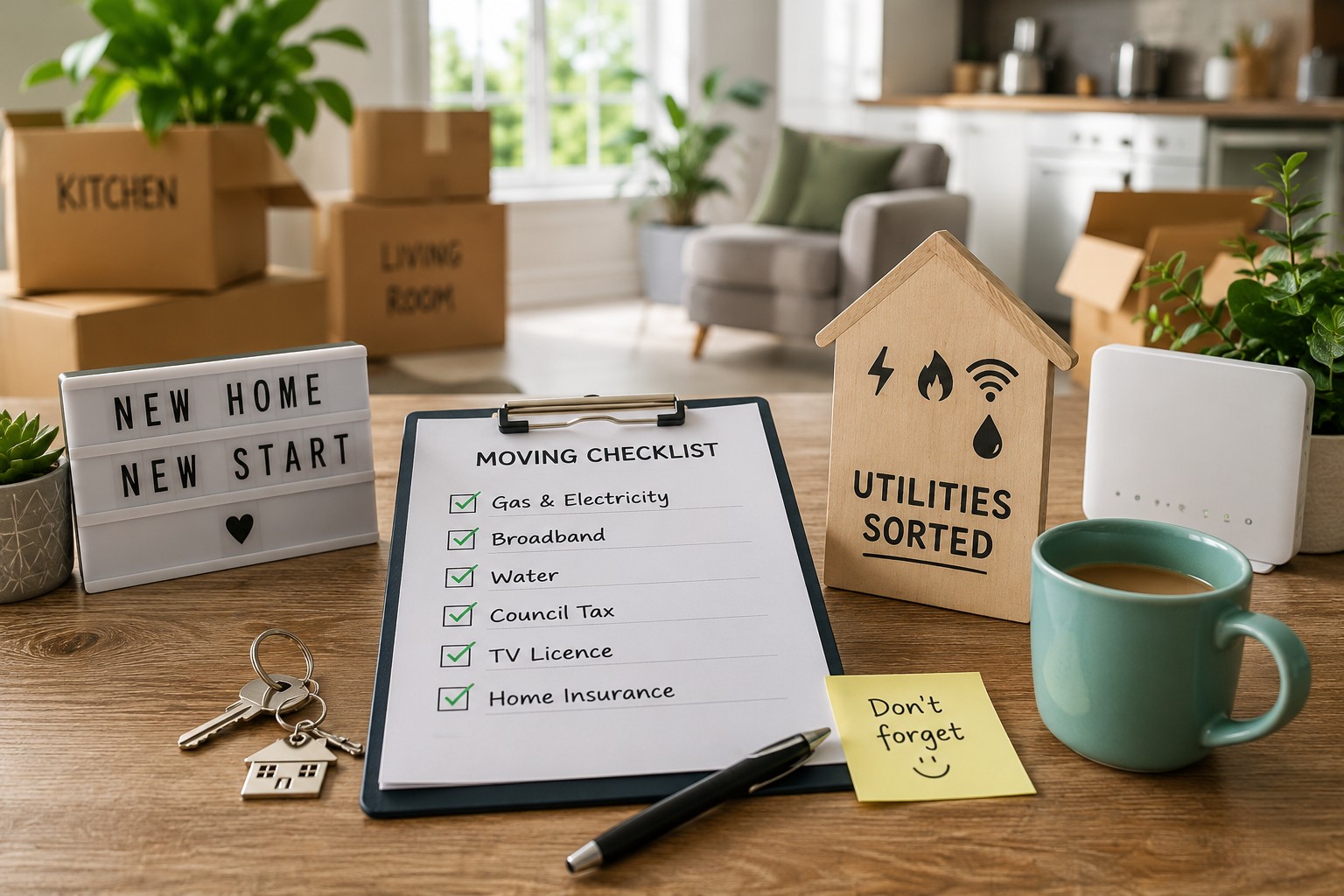
Moving house isn't just about packing boxes and unpacking them again at the other end, even though that's what we usually associate the whole process with. There is also quite a lot of admin to deal with, including sorting out your electricity and gas, broadband, water and other household services.
Moving home is a complicated process, and with so much happening at once, it's easy to forget something. Some things need to be arranged well before moving day, others should be done on the day itself, and a few can only be sorted once you've moved into your new home.
That's why being organised can save you from some very common and very frustrating problems, such as paying bills for your old property, being without broadband for weeks or ending up on a tariff that doesn't suit you.
In this guide, we'll explain how to set up utilities when moving house in the UK, what you need to do and when to do it, so you can avoid as many unnecessary problems as possible.
1. What utilities do you need to sort out when moving house?
Before you start contacting providers, it’s worth making a simple list of everything connected to your old and new house. The main things you will need to think about are:
Electricity
Gas
Broadband
Water
Council Tax
TV licence
Home insurance- it isn't technically a utility, but while you're sorting out everything else connected to your move, it's definitely something worth having on your list.
2. Contact your current energy supplier before you move
Don't wait until you've already moved out to think about your gas and electricity account.
Before moving day, contact your current energy supplier and let them know you're leaving the property. Citizens Advice recommends giving your gas and electricity suppliers at least 48 hours' notice before you move (Citizens Advice, 2026).
When you contact your supplier:
Tell them you're moving home
Give them your moving date
Provide a forwarding address so they can send your final bill
Ask whether your current tariff can move with you or whether the account needs to be closed
If you're on a fixed tariff, check whether any exit fees apply
Don't assume your account will automatically close when you leave the property
It's a small job, but sorting it out before moving day can save you from dealing with unnecessary bills and phone calls once you're already trying to settle into your new home.
3. Take meter readings on moving day
This is a really important step and one that's very easy to forget when you're surrounded by boxes and trying to get everything out of the house.
On the day you move out:
Take a reading from your electricity meter
Take a reading from your gas meter, if you have one
Take clear photos of the meters and readings
Keep a record of the date the readings were taken
Send the final readings to your supplier
Keep the photos somewhere safe in case there is ever a problem with your final bill
Citizens Advice recommends taking meter readings on the day you move out and keeping a record of both the readings and the date in case you later disagree with your final bill (Citizens Advice, 2026).
4. Find Out Who Supplies Your New Home
When you move into a new home, the property will already have gas, electricity and water suppliers connected. You'll usually be placed on a deemed contract with the existing gas and electricity suppliers until you decide whether to stay with them or switch to a different tariff.
Once you've taken your opening meter readings and contacted the current supplier to set up your account, it's worth comparing your options. Moving house is one of the best opportunities to review your household bills, and switching provider could help you save money.
Compare Utilities and Broadband with Movly
With the Movly App, you can compare gas, electricity and broadband providers in one place, making it easy to find competitive deals before or shortly after you move into your new home.
Using Movly, you can:
✅ Compare gas and electricity providers
✅ Compare broadband deals
✅ Find competitive tariffs for your new home
✅ Set up your essential services before moving day
If you prefer to compare online, you can also use our utility comparison service:
👉 Compare energy deals: https://movly.myutilitygenius.co.uk/#/switch/home-energy
Whether you're moving into your first home or your fifth, arranging your utilities and broadband early helps make settling into your new home much smoother.
💙 Movly Tip: Order your broadband 2–3 weeks before moving day where possible. This gives your new provider enough time to activate your service, reducing the chances of moving into a home without internet access.
5. Should You Stay With the Existing Energy Supplier or Switch?
Once you've moved in and found out who currently supplies your gas and electricity, you don't have to stay with them forever.
If you're responsible for paying the energy bills, you can choose your own supplier and tariff. So before simply accepting whatever tariff is already connected to the property, take a little time to check your options. Ofgem confirms that after moving into a new home, you can choose another tariff with the existing supplier or switch to a completely different supplier (Ofgem, 2026).
When comparing energy deals, don't look only at the estimated monthly payment. Check:
the unit rate for gas and electricity
the standing charge
whether the tariff is fixed or variable
the length of the contract
any exit fees
how the tariff compares based on your expected energy usage
The cheapest-looking monthly payment doesn't necessarily mean you've found the best tariff for your household.
Moving house is actually a good opportunity to check what you're paying rather than automatically staying with the first option you're given.
You can also compare gas and electricity tariffs through the Movly App, making it easy to organise your move and household bills in one place.
6. Set Up Your Broadband as Early as Possible
Broadband is definitely one of those things you don't want to remember about while sitting in your new home surrounded by boxes and wondering why you have no Wi-Fi.
Unlike turning on the lights, getting broadband set up isn't always instant. Depending on the property and provider, you may need an installation or engineer appointment, so it's worth looking into your options before moving day.
Start by checking:
whether your current provider is available at your new address
what broadband speeds are available at the new postcode
whether you can move your existing contract
whether you're still within your minimum contract period
whether early termination charges apply
whether another provider offers a better speed, price or package
whether an engineer visit or new installation is required
Ofcom recommends checking broadband availability and speeds at your new property before you move. If you decide to change provider, the One Touch Switch process means that in many cases you only need to contact your new broadband provider and they will arrange the switch for you (Ofcom, 2026).
If you work from home, rely heavily on the internet or have children who would consider a week without Wi-Fi an actual emergency, this is one job you probably don't want to leave until the last minute.
💙 Movly Tip: Compare broadband providers as soon as your moving date is confirmed. With the Movly App, you can compare deals for your new postcode and choose a package before moving day, helping you avoid delays once you've moved in.
7. Don't Forget About Water
Water is slightly different from gas and electricity.
You generally can't simply shop around and choose a domestic water company in the same way you can choose an energy or broadband provider. Your water company is normally determined by the area you live in.
Before you move, let your current water company know you're leaving and give them your new address. If you have a water meter, Citizens Advice recommends giving the company at least five working days' notice so a final reading can be arranged (Citizens Advice, 2026). Otherwise, you could potentially be charged for water used after you've moved out.
When you arrive at your new property:
Find out which water company covers your new address
Set up your new account
If there's a water meter, take a reading as soon as you move in
Keep a photo of the reading for your records
If you're staying within the same water company's area, you still need to tell them you've changed address. It's a five-minute job that's very easy to forget when there are fifty other things happening.
8. Update Your Council Tax
Council Tax should also be high on your moving checklist. You need to tell your current council that you're leaving your old property and provide the date you're moving out. If your new home is in a different council area, you'll also need to register with your new local authority.
Remember to check:
the date you're no longer responsible for the old property
whether you have a final balance to pay
whether you're due a refund
when your Council Tax responsibility starts at the new property
whether you're entitled to any discounts
Don't assume that your old council will automatically know you've moved simply because you've registered somewhere else.
If you're the only adult counted for Council Tax purposes in your new home, you may be eligible for a 25% discount. Check with your local council, as eligibility depends on your household circumstances (GOV.UK, 2026).
9. Don't Forget Your TV Licence
Another small thing that's surprisingly easy to forget: your TV Licence. Your licence is connected to your address, so if you're moving home you'll need to update your details (TV Licensing, 2026). Don't assume that because you already pay for a TV Licence, everything will automatically follow you to the new property. Add it to your address-change list and get it sorted alongside your other household accounts. It's much easier to spend a few minutes updating it during the move than realise weeks later that it's still registered at your old address. If you no longer need a TV Licence at your new home, check the TV Licensing rules before updating or cancelling it (TV Licensing, 2026).
10. Moving Into a Rented Property? Check These Things First
If you're renting your new home, there are a few extra things worth checking before you start changing suppliers or setting up accounts. First, read your tenancy agreement.
Check:
whether gas and electricity are included in your rent
whether water is included
who is responsible for Council Tax
who currently supplies energy to the property
whether your tenancy agreement says anything about switching supplier
whether you need to inform your landlord or letting agent before switching
If you pay the energy bills directly, Ofgem says you can generally choose your own energy supplier and tariff (Ofgem, 2026). However, it's still worth checking your tenancy agreement because it may contain conditions about notifying your landlord or returning the supply to a particular provider when you leave. And one more thing: take photos of the meters when you move in. Even if the readings are included in your check-in report, having your own photos takes seconds and gives you a record of exactly what the meters showed when you became responsible for the property.
Once you've confirmed you're responsible for the bills, use the Movly App to compare gas, electricity and broadband providers for your new address, helping you find the right deal without visiting multiple comparison websites.
11. Create a Moving Utilities Checklist
It's very easy to tell yourself: "I'll remember that."
Then moving week arrives, you're surrounded by boxes, someone is asking where the kettle is, you've made fifteen phone calls and suddenly you can't remember whether you actually contacted the water company or just thought about doing it. Don't rely on your memory. Create a simple utilities checklist and tick things off as you complete them.
This is exactly why Movly's 8-week moving timeline brings these types of tasks together in one place. You can see what needs doing, tick off completed tasks, add your own and use reminders instead of trying to keep your entire move in your head. Because moving house already gives you enough to think about. Your utility accounts don't need to be one more thing you're trying to remember.
Final Thoughts
Utilities probably aren't the most exciting part of moving into a new home. Nobody gets the keys and thinks, I can't wait to sort out my Council Tax and electricity tariff. But getting these things organised early can save you a lot of unnecessary stress later. Start before moving day where you can, keep records of your meter readings, check what's already connected at your new property and don't automatically accept the first tariff you're given. A little organisation now can help you avoid double bills, missed payments, the wrong tariff or spending your first few weeks in your new home waiting for Wi-Fi. Because on your first evening in your new home, you want to be sitting among the boxes with a cup of tea and working Wi-Fi- not trying to work out who actually supplies your electricity.
Compare All Your Household Bills in One Place
Moving home is the ideal time to review your monthly bills. Rather than automatically staying with your current providers, comparing deals could help you reduce your household costs from day one.
With the Movly App, you can:
✅ Compare gas and electricity providers
✅ Compare broadband deals
✅ Arrange your essential services before moving day
✅ Manage your entire move with a personalised checklist
Prefer to compare online?
👉 Compare energy deals: https://movly.myutilitygenius.co.uk/#/switch/home-energy
Or download the Movly App to organise your entire move in one place.
Frequently Asked Questions
When should I set up utilities when moving house in the UK?
It's best to start organising your utilities before moving day rather than waiting until you're already in your new home. Contact your current energy supplier before you move, arrange broadband early if possible and make a list of all the accounts that need updating. Some tasks, such as taking final and opening meter readings, should be done on moving day itself.
What happens to gas and electricity when I move house?
Your new home will usually already have an existing gas and electricity supplier. When you become responsible for the property, you'll initially receive energy from that supplier. You can then decide whether to stay on their tariff, choose another tariff or switch to a different supplier (Ofgem, 2026).
How do I find out who supplies gas and electricity to my new home?
If you don't know your new electricity supplier, you can find your local electricity network operator using your postcode and use the available lookup services. For gas, you can use the Find My Supplier service. Ofgem provides guidance for finding both your energy supplier and network operator (Ofgem, 2026).
Can I compare broadband and energy through Movly?
Yes. The Movly App lets you compare gas, electricity and broadband providers, helping you find suitable deals for your new home while managing your moving checklist, removals and other moving tasks in one place.
Can I arrange broadband before I move into my new home?
Yes, and it's often worth looking into broadband before moving day. Check which providers and speeds are available at your new postcode, whether you can transfer your existing contract and whether an engineer appointment or installation will be required. Setting it up early can reduce the risk of spending your first weeks in your new home without broadband.
Do I need to take meter readings when moving house?
Yes. Take gas and electricity meter readings when you leave your old property and again when you become responsible for your new home. Keep a record of the readings and, if possible, take photos so you have evidence if there is ever a disagreement about your bill (Citizens Advice, 2026).
Who do I need to notify when moving house in the UK?
Alongside your gas, electricity, water and broadband providers, remember to update other important organisations and services. These may include your local council for Council Tax, TV Licensing, your bank, insurance providers, DVLA, HMRC, your GP and your child's school or nursery. Creating a moving checklist can make it much easier to keep track of who you've already contacted.
References:
Citizens Advice. Moving home – dealing with your energy supply
Citizens Advice. Moving home and water bills
Ofgem. Get energy if you are moving home or business premises
Ofgem. Find your energy supplier
Ofcom. Switching broadband provider
GOV.UK. Paying the right level of Council Tax: a plain English guide to Council Tax
TV Licensing. Moving home – updating your TV Licence
TV Licensing. Check if you need a TV Licence